

Jean-Honoré Fragonard, an 18th century painter, decides to use as a model a young washerwoman, Marianne, with whom he ends up falling in love.Read More »
Jean-Honoré Fragonard, an 18th century painter, decides to use as a model a young washerwoman, Marianne, with whom he ends up falling in love.Read More »

Mr. Desgrands, a wealthy bourgeois, often changes his maid. The new one, Suzon, is very appetizing. And not shy at all. On the other side of the wall, through a cleverly dug hole, Jean the nephew doesn’t miss a moment of the show.Read More »
Old landlord, Gustave is after beautiful maid Celestine while he is very afraid of his dominant wife Jeanne. But Celestine wants baker’s teenage son.Read More »
Written by Antoine Gallien
inspired by the writings of Jean de La Fontaine and Niccolo MachiavelliRead More »
Old weaver’young and dissatisfied wife behaves badly to her husband’s cousin, Marietta and has an affair with worker, Luke. Marietta makes a plan for revenge.Read More »

Giant of cinema, the embodiment of creation, Orson Welles is the man who reinvents the film language at 24-years old. Who is hidding behind this impressive figure? This movie is a journey towards the man behind the legend. It drags us into the labyrinth with multiple mirrors that Welles erases and recreates at the mercy of his imagination.Read More »

First feature length film by Hervé Le Roux, director of Reprise (1996). With Lucas Belvaux, Marilyne Canto, Nathalie Richard, Eva Ionesco, László Szabó, Arielle Dombasle, Rosette.
“Judith, Charly, Caroline, and Nanou, plus their men friends, are semi-Bohemians in Paris, avoiding paying rent, and encouraging each others’ efforts to make movies, produce plays, and play music. They tease, confide, share beds, talk, and drink with each other. Things may go on forever like this when Nanou announces that she’s pregnant with Luc’s child, and they plan to move to Marseilles. This is somewhat upsetting to Luc’s sometime male lover, but life and these friendships go on, with good humor.”Read More »

Godard’s last film, a trailer for a movie that will never exist, shows a series of collages on what appears to be photographic paper, and is about Belgian surrealist/poet Charles Plisnier, who was expelled from the Communist party in 1937.
Quote: A few months before he left the screen for all eternity, Jean-Luc Godard put the finishing touches to a one-of-a-kind, nineteen-minute short that the Festival de Cannes is honoured to present in a world première. Fabrice Aragno, one of his closest colleagues, reflects on how Drôles de guerres came to be — a film that sets out to ‘shape thought‘.Read More »
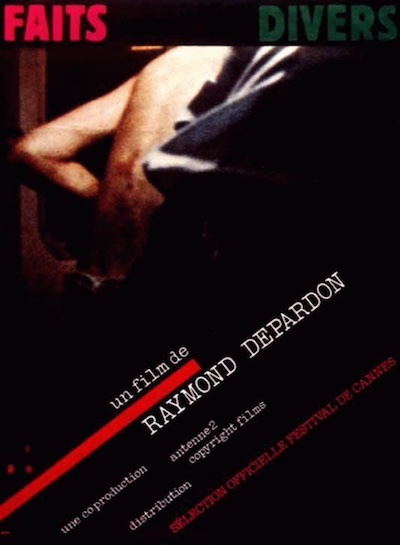
Paris, summer 1982. The day to day life of a police station in the 5th arrondissement of Paris. Day and night a reporter follows small groups of uniformed police officers who patrol the neighbourhood in their vans, intervene at the slightest radio call, prepare reports or question defendants at the central station.
Shot alone by Depardon, Faits divers (News Items) is a live report, without a commentary, on the day to day activities of police officers in the 5th arrondissement of Paris. By observing the police officers, Depardon’s camera reveals the hidden side of Paris. The Paris of everyday assaults, poverty and distress. In a way, he opened a cycle of films on those who had been forgotten by everyone and began to give them a voice as he explained: “The shooting was laborious, but in this film, I was able to record the words of individuals who never have access to the media […] Is Paris a difficult city to live in? Or a city where you get help? There is probably a French-style violence, and the police officers are poorly prepared social workers.”Read More »