Federico Fellini

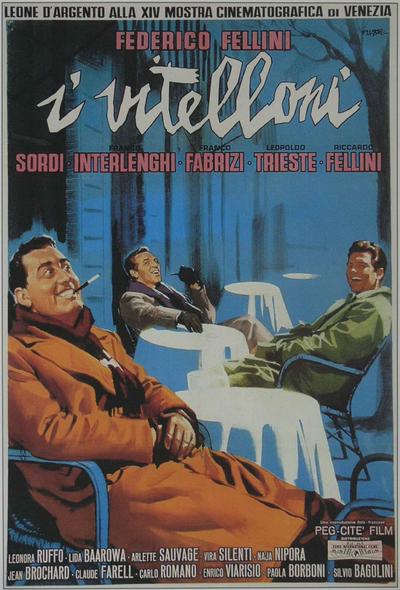
  • Federico Fellini – I vitelloni (1953)

    1951-1960ComedyDramaFederico FelliniItalian Neo-RealismItaly

    29f7c043f76a2bde437fd0d52a185152

    Quote:
    Five men walk arm-in-arm through a sleepy Adriatic town, their lockstep a gentle echo of Italy’s Fascistic past. Such posses are quite common in Italy, where close male friendships, equal parts sensuality and ritual, are second only to the family in importance. I Vitelloni (the best sense of it is “the idlers”), Fellini’s third film, includes some of his most subtle filmmaking and most personal material. Loosely structured and oddly narrated, I Vitelloni is like a sketch for both La Dolce Vita and Amarcord. Paradoxically, I Vitelloni is also an insightful and accurate representation of Italy in the immediate postwar period, full of references to the massive social changes underway. Fifty years after its release, I Vitelloni can finally be seen as a seminal film in Italian cinema, one of the first to detail the effects of technology, celebrity, and mobility on Italian life.Read More »

  • Federico Fellini – Intervista [+extras] (1987)

    1971-1980ComedyFantasyFederico FelliniItaly

    29f7c043f76a2bde437fd0d52a185152

    Synopsis:
    Cinecitta, the huge movie studio outside Rome, is 50 years old and Fellini is interviewed by a Japanese TV crew about the films he has made there over the years as he begins production on his latest film. A young actor portrays Fellini arriving at Cinecitta the first time by trolley to interview a star. Marcello Mastroianni dressed as Mandrake the Magician floats by a window and Fellini followed by TV crew takes him to Anita Ekberg’s villa where the Trevi fountain scene from Dolce vita, La (1960) is shown on a sheet that appears and disappears as if by magic.Read More »

  • Federico Fellini – La città delle donne AKA City of Women (1980)

    1971-1980DramaFantasyFederico FelliniItaly

    29f7c043f76a2bde437fd0d52a185152

    Marcello is in the compartment of an Italian train, facing forward when the mineral water of the woman seated across from him starts to fall toward him. He catches the bottle and makes eye contact and follows her when she leaves the compartment. For a few moments she finds him attractive too. Then suddenly she gets off the train and starts walking through a field. Marcello follows her, loses her, finds himself in a large hotel surrounded by women. A feminist conference is taking place and he tries to escape. Read More »

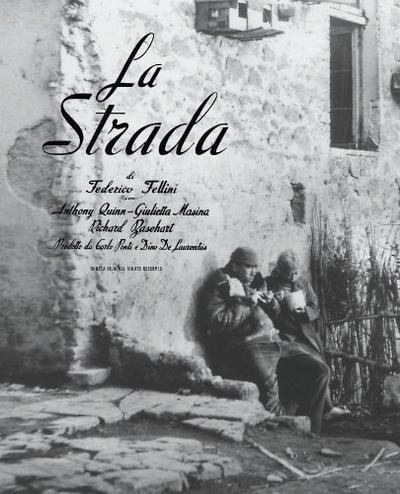
  • Federico Fellini – La Strada AKA The Road (1954)

    1951-1960DramaFederico FelliniItaly

    29f7c043f76a2bde437fd0d52a185152

    Quote:
    La Strada is Federico Fellini’s moving masterpiece that explores the soul’s eternal conflict between the heart and mind. Zampano (Anthony Quinn) is a cruel, traveling carnival strongman who buys his assistant, a simple minded young woman named Gelsomina (Giulietta Masina), from her poverty-stricken family. Gelsomina is innocent and childlike (Masina’s exquisite performance is as comic as it is heartbreaking). She does Zampano’s bidding without question or resistance, even though he is abusive to her. He abandons her in the street to spend the night with a woman. He lashes her with a tree branch when she misquotes her introductory lines. He forces her to steal from a convent. Yet, she remains faithful and uncomplaining.Read More »

  • Federico Fellini – La Dolce Vita (1960)

    Drama1951-1960ArthouseFederico FelliniItaly

    Quote:
    The biggest hit from the most popular Italian filmmaker of all time, La dolce vita rocketed Federico Fellini to international mainstream success—ironically, by offering a damning critique of the culture of stardom. A look at the darkness beneath the seductive lifestyles of Rome’s rich and glamorous, the film follows a notorious celebrity journalist (a sublimely cool Marcello Mastroianni) during a hectic week spent on the peripheries of the spotlight. This mordant picture was an incisive commentary on the deepening decadence of contemporary Europe, and it provided a prescient glimpse of just how gossip- and fame-obsessed our society would become.Read More »

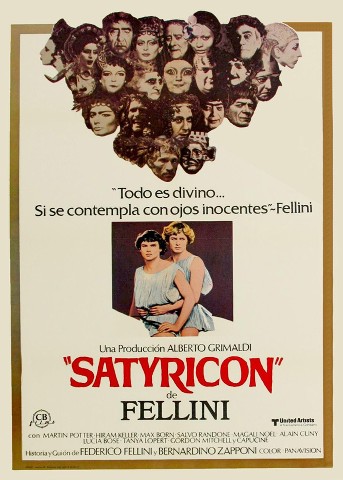
  • Federico Fellini – Fellini – Satyricon [+Extra] (1969)

    1961-1970ArthouseFantasyFederico FelliniItaly

    29f7c043f76a2bde437fd0d52a185152

    Quote:
    In first century Rome, two student friends, Encolpio and Ascilto, argue about ownership of the boy Gitone, divide their belongings and split up. The boy, allowed to choose who he goes with, chooses Ascilto. Only a sudden earthquake saves Encolpio from suicide. We follow Encolpio through a series of adventures, where he is eventually reunited with Ascilto, and which culminates in them helping a man kidnap a hermaphrodite demi-god from a temple. The god dies, and as punishment Encolpio becomes impotent. We then follow them in search of a cure. The film is loosely based on the book Satyricon by Gaius Petronius Arbiter, the “Arbiter of Elegance” in the court of Nero. The book has only survived in fragments, and the film reflects this by being very fragmentary itself, even stopping in mid-sentence.
    Read More »

  • Federico Fellini – Roma AKA Fellini’s Roma [+Extras] (1972)

    1971-1980ArthouseDramaFederico FelliniItaly

    The New York Times review, Published: October 16, 1972

    Roger Greenspun wrote:
    “Fellini’s Roma” is perhaps three-quarters Fellini and one-quarter Rome; a very good proportion for a movie. Although an appreciation of the city informs every part of the movie, Rome is not so much the subject as the occasion for a film that is not quite fiction and surely not fact, but rather the celebration of an imaginative collaboration full of love and awe, suspicion, admiration, exasperation and a measure of well-qualified respect.Read More »

  • Federico Fellini – I vitelloni (1953)

    1951-1960ArthouseDramaFederico FelliniItalian Neo-RealismItaly

    Free Image Hosting at www.ImageShack.us

    29f7c043f76a2bde437fd0d52a185152

    Quote:
    Federico Fellini’s second feature, *I Vitelloni* (literal trans.: “fatted veal calves”; figurative trans.: “the guys”), is an honest, unpretentious work from the Master before he became besotted with his own self-indulgence.

    It’s autobiographical in several indirect ways. The depictions here of young men who are not quite so young anymore, living with their mothers, settling for dead-end jobs or simply not working, and generally languishing their lives away, are based on Fellini’s own observations of such fellows in his boyhood home of Rimini. Autobiographical too in its sense of style: the movie is inescapably stamped by the Neo-Realism of Fellini’s apprenticeship. The grimy faces of working-class people, crumbling tenements, and weed-choked rail-yards are all here. But with a difference: Fellini casts a critical eye on this scene, eschewing the usual Neo-Realist appeal to our presumed socialist sympathies. *I Vitelloni* is not a political film in the usual mid-century Italian manner. Fellini gives us a quintet of heroes who, for the most part, aspire to be bourgeois big-shots of their shabby seacoast town. Not content with that, he makes them lazy, as well . . . and then he asks us to root for them, to actually like them! Needless to say, the intelligentsia of the period didn’t warm to this film, even as the film-going public in Europe loved it, recognizing themselves and their friends and their own hometowns in it.Read More »

Back to top button