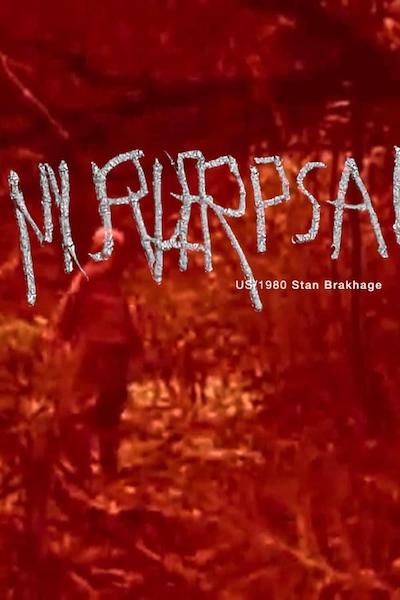
PLOT
Young people playing and dribbling with a ball, as seen from the ball’s point of viewRead More »


PLOT
Young people playing and dribbling with a ball, as seen from the ball’s point of viewRead More »

Deck brings emphasis to the bodily experience of temporality. The principle of harmonized rhythm underpins all of Pierce’s work from the shooting (live animation) performance, to its editing and sound design, and finally in situating its reception. In all of his video and sound art, repetition and rhythm manifest the echoes and arcs of our irregular and subjective conjectures of time.Read More »

Synopsis
Things spin: amusement park rides, a phonograph record. A man wakes, shaves, and takes a phone call. Another man, in a kimono, walks in the woods, stops, and opens a small decorative box on the forest floor. People at an amusement park called Little Harlem enjoy themselves. A man walks through another amusement park, called Cavalcade Worlds, as midway rides spin. At a house, an older woman cleans; a pre-teen girl sets the table; a teenaged boy showers. After he dresses, he holds a candle high above his head and walks swiftly toward a young man standing bare-chested, his arms extended. A man arrives home where the girl has set the table. The youth sleeps. Christmas?Read More »


Between documentary and fiction, The master and the giant approaches the topic of the rivalry in the creation: a first God created the world, a second God destroyed it to build one new, better. Myth and reality meet in this film that puts in scene two different universes: a man and a woman in a neighborhood in demolition of Amsterdam, and images of the life in the confines of the tunecian Sahara. (Written in collaboration with Claude Ménard.)Read More »

The shooting diary of a film shot in France and in the United States. Using photos of Paris and of New York City, excerpts of his former films, statements by friends of his and shooting sequences of the film itself, tormented filmmaker Marcel Hanoun has made a heterogeneous and unclassifiable film about the difficulty of filming.Read More »


Quote:
In early spring of 1966, in anticipation of his eventual departure from the Greenwich Village apartment in which he had been living for a number of years, [Markopoulos] filmed the revelatory seven-minute interior portrait Ming Green , titled for the deep spruce color of the apartment’s walls. Ming Green was edited entirely in-camera, and its precise rhythmic blossoming is based on overlapping dissolves and longer flashes, rather than single-frame clusters. The film’s complex harmonic structure, however — as well as its incorporation of often static, “single” images that may be comprised of more than one frame — echoes the montage techniques developed in Twice a Man (1963). Interweaving mementos with foliage, color, and light, Ming Green suggests the inextricability of past and present: despite its exquisite lightness, it could represent the passage of hours and days rather than minutes. -Kristin Jones, Millennium Film Journal, 1998Read More »


A Filipino poet named Benjamin Agusan (Roeder Camanag) is the hapless native who returns to his hometown Padang to witness the aftermath of the super typhoon. For the past seven years, Benjamin had been living in an old town called Kaluga in Russia. With his grant and residency, he taught and conducted workshops in a university. The poet published two books of sadness and longing in the process. In Russia, Benjamin was able to shoot video collages, fell in love with a Slavic beauty, buried a son, and almost went mad. He came back to bury his dead-father, mother, sister and a lover. He came back to face Mount Mayon, the raging beauty and muse of his youth. He came home to confront the country that he so loved and hated, the Philippines. He came back to die in the land of his birth. He wanders around the obliterated village meeting old friends and lovers.Read More »

Quote:
Distributed by L’Italnoleggio Cinematografico, with Sven Lasta, Rada Rassimov, Claudio Volonte, Jean Martin, Milena Vucotic
Presented at the Venice Biennale 1974.
Segnalazione ufficiale della Critica Cinematografica (SNCCI)
Winner of the Nastro d’Argento 1975.
Presented at the Festival du Jeune Cinéma de Toulon 1975.
Presented at the Festival of New Delhi 1976.
Presented at the Italian Film Festival in London (British Film Institute) 1976.
Invited to the Festival of Valladolid 1975.Read More »

To mark her 50th birthday, filmmaker Lynne Sachs gathers a group of her contemporaries—all New Yorkers but originally hailing from all corners of the globe—for a weekend of recollection and reflection on the most life-altering personal, local, and international events of the past half- century, creating what Sachs calls “a collective distillation of our times.” Interspersed with poetry and flashes of archival footage, this poignant reverie reveals how far beyond our control life is, and how far we can go despite this.Read More »