
An emblematic film having as a guiding thread the clothes spread on the poles.Read More »
An emblematic film having as a guiding thread the clothes spread on the poles.Read More »


A premonition of a horror film, lurking danger: A house – at night, slightly tilted in the camera’s view, eerily lit – surfaces from the pitch black, then sinks back into it again. A young woman begins to move slowly towards the building. She enters it. The film cuts crackle, the sound track grates, suppressed, smothered. Found footage from Hollywood forms the basis for the film. The figure who creeps through the images, who is thrown around by them and who attacks them is Barbara Hershey. Tscherkassky’s dramatic frame by frame re-cycling, re-copying and new exposure of the material, folds the images and the rooms into each other. Read More »

Quote:
Her Heart is Washed in Water and Then Weighed is a meditation on motherhood and mortality that takes its title from a procedure in the autopsying of a human corpse. Subtle juxtapositions evoke parallels between static monuments and living families to suggest what is lost to time and age. When you die, everything you know – including this – disappears.Read More »
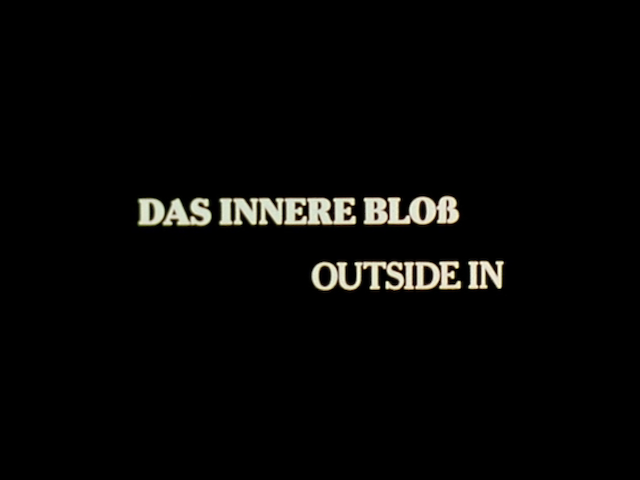
continuing with liner notes by Michel Barthelemy :
“This is probably a good time to mention Dwoskin’s use of comedy : Outside in is a film that deals with disability but is also funny and even burlesque. Of course, only the disabled can use this mode to stage themselves as disabled characters.
Bergson states not only that “a deformity thay may become comic is a deformity that a normally built person, could succesfully imitate” but also that “the impression of the comic will be produced (…) when we are shown the soul tantalised by the needs of the body : on the one hand, the moral personnality with its intelligently varied energy, and on the other, the stupidly monotonous body, perpetually obstructing everything with its machine-like obstinacy. The more paltry and uniformly repeated these claims of the body, the more striking will be the result”Read More »

Without turning his back on his earlier experiments with testing the boundaries, Dwoskin made fictional films, including a superb adaptation of Frank Wedekind’s Tod und Teufel, in which voids and slips are filmed during acts of speech, rather than the characters and their actions.Read More »

given how he arrived in the world of film, Dwoskin is usually considered to be an experimental film-maker, which he, like any genuine artist, evidently is, but this attitude leads to a misunderstanding, and makes his films difficult to distribute, because his films are immediatly assumed (in a humdrum, unthinking world) to be primarly dominated by considerations of form rather than substance, and thus not only inaccessible to, but also uninterested in attracting, a broader audience
But Dwoskin words do not bear this out. As early as 1981, he explained how “Behindert was intended for a television audience and it was easier to get my message accross by showing myself directly on screen. My aim is to make films that work both in the cinema and on television”(…)Read More »

The Green Elephant also known as Green Elephant Calf) is a 1999 Russian gore film directed by Svetlana Baskov. The film could not be distributed through the mainstream film circuit in Russia, due to its extremely violent images and obscene language. The International Film Festival Rotterdam programme commented that “Green Elephant is even more urgent because of the escalation of the war in Chechnya and growing criminality in the Russian armyRead More »

‘The Silent Cry is a fictionalised narrative film, based on documentary facts and extracts of one English girl’s memories and thoughts, all surrounded, and directed towards her particular dilemma. This dilemma can be summarized as her basic inability to have relationships, especially sustained relationships, and particularly with men. This is the total of her statement and the film. The construction and flow of the film follows the way she thinks – it is her point of view that is followed in the film. So all things are the way she remembers and dwells on them, and which are important to her.’ – S.D.Read More »

Quote:
Moon and sun are elliptically and stroboscopically conjured in Joshua Gen Solondz’s cloistered yet operatic Luna e Santur. In milky, hand-processed images, hooded figures recalling Magritte’s The Lovers enact a series of rituals in which an old trauma is remembered and exorcized.Read More »