

IMDB:
Otanes is certain that Smerdis, King of Persia is an impostor. He gathers together a group of people to stage a coup, only to face the question of which one of them will be worthy to take the thrown.Read More »
IMDB:
Otanes is certain that Smerdis, King of Persia is an impostor. He gathers together a group of people to stage a coup, only to face the question of which one of them will be worthy to take the thrown.Read More »
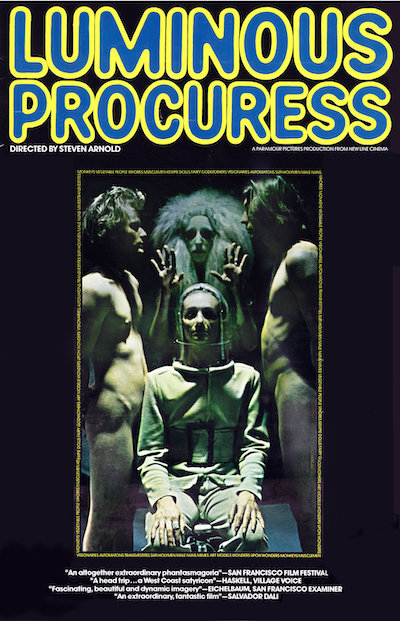
Dalí considered Luminous Procuress ‘a work of genius’. Featuring members of legendary San Francisco performance troupe The Cockettes, the film was directed by the artist and filmmaker Steven Arnold, a muse and model of Dalí’s. Dalí always referred to Arnold as his ‘prince’, and allegedly co-produced (or at least partly funded) the film, for which he held an elaborate screening at the St. Regis Hotel in New York. Andy Warhol and numerous luminaries of New York society attended the spectacular event, and Dalí projected the film upside down, backwards and sideways. The Village Voice called the film ‘a tour de force of the imagination – a journey through peekboxes of naked tableaux, theatres of mechanical dreams, feasts of monsters and piles of humanity.’Read More »

Quote:
Kaul’s film addresses the writings of Gajanan Madhav Muktibodh (1917-79), one of the main representatives of the Nai Kavita (New Poetry) movement in Hindi. Muktibodh also wrote several short stories, one of which provides the film with its title, and critical essays. The film integrates episodes from Muktibodh’s writings with material from other source, including a reinvented neo-realism derived from Muktibodh’s literary settings. The narrative is constructed around 3 characters. Ramesh (Gopi) iis one who speaks and enacts Muktibodh’s writings, functioning as the first-person voice of the text; his two friends, , Madhav (Jha) and Keshav (Raina), are Ramesh’s antagonists and interlocuters esp. in the debates about modernity. Kaul gradually minimizes the fictional settings until, in the remarkably shot sequences of the factory, the audience is directly confronted with the written text itself.Read More »

Shot during the opening stages of the First Gulf War, Kerr’s “Cruel Rhythm” revisits the American desert for a cinematic tone poem in the vein of ‘The Last Days of Contrition’ A canopy of sound bites of media coverage on the build-up toward the war is juxtaposed with the alienness of windmills in the desert, and a startling sequence of drifting faces of a crowd coming towards the camera in slow motion. A thought-provoking piece on media’s construction of societal paranoia “Cruel Rhythm” is an attempt to make a public, shared feeling intimate, or conversely, to make a subjective feeling of floating anxiety and dread into a shared representation.” Unsettlingly, its ambiance is as poignant today as ever.Read More »

Four Third-World Christs try to stop the American industrialist John Brahms in Glauber Rocha’s experimental film inspired by Pier Paolo Pasolini’s murder.
The day that Pier Paolo Pasolini was killed, Glauber Rocha decided to make this film about the life of Christ in the Third World. Starting from a dialectical synthesis between capitalism and socialism, and a search of interracial relationships in Brazil, Rocha created a work of religious and prophetic tone that results in a kind of bewilderment contemplative, now lyrical, now frantic, soaked in a new messianism. In his last film, the director proposed a tune of sounds and images that build a picture of Brazil and a portrait of himself.Read More »

After Kanchana Seeta (1977), the mythical dimension of Aravindan’s cinema acquires a quasi-real, quasi-mythical character in Esthappan (1980). Esthappan is a mysterious figure, allegedly immortal, in a Christian fishing village in Kerala. An enigmatic figure defying spatiotemporality, like many others in Aravindan’s films, Esthappan resides at the periphery of society. Although a more earthly version of Kummatty (the subject of Aravindan’s previous film), all manner of virtues and magical powers are ascribed to the Christ-like worker of miracles (including printing his own money and drinking whisky without getting drunk).Read More »

Not much info in English for this one:
The director of this movie put an advertisement in many Yugoslav papers calling everybody who wants to act in movie regardless of age, looks, or profession, to reply. From 7000 arrived letters, about 30 heroes were picked up for the movie and its story was made based on what they wished to play.Read More »

WARNING: This work contains throbbing light. Should not be viewed by individuals with epilepsy or seizure disorders.
Synopsis (by Mark McElhatten)
The cast is in flux — the animate and the inanimate get double billed with that dynamic duo — Push and Pull. If matter has consciousness and has renounced movement as Henri Bergson suggests, in order to conserve energy, then here we have a dramatic apostasy. A broken vow of stasis, a flood of energy. What beautiful instability and pulsation in this floating world off a hinge, drawn through invisible bellows, exhaled, exultant. Read More »

More a work in experimental Dadaism than a film, «Le Retour à la raison» was the first film to be made by the celebrated surrealist artist, Man Ray. The American-born artist made the film soon after he moved to Paris in the early 1920s to found the Dada movement.
The film is very short (three minutes in length) but includes some astonishing and evocative images. The early segments of the film iillustrates a technique which Man Ray pioneered in static photography, the rayograph (or photogramme). Here, an object is placed between a light source and photo-sensitive film, in contrast to traditional photography where photographic film captures light reflected off an object. Read More »