Drama

  • Sergei M. Eisenstein – Bezhin lug AKA Bezhin Meadow (1937)

    1931-1940DramaSergei M. EisensteinShort FilmUSSR

    29f7c043f76a2bde437fd0d52a185152

    This short film is only still-image restoration of an unfinished film.

    What is one to make of Bezhin Meadow? What is one to make of Sergei Eisenstein? The questions are in many ways the same as this film maudit and its maker are in much the same boat these days – lost to history both artistic and political. Filmed between 1936 and 1937 Bezhin Meadow was to signal Eisenstein’s return to the Soviet fold after his sojourn in America and the debacle of Que Viva Mexico. What resulted was an even greater debacle in that no sooner had the film neared completion than it was attacked and banned from view – with Eisenstein contributing to the banning by penning an essay in which he ‘confessed’ to the ‘mistakes’ of Bezhin Meadow. Finally adding injury to insult, the sole surviving print of Bezhin Meadow was destroyed – supposedly in a bombing raid during World War II, but just as likely burned outright. Then around 1968 a ‘reconstruction’ of the film was engineered when splices from the editing table, saved by Eisenstein’s wife, Pera Attasheva, were discovered. Cobbled together with a track of Prokoviev music, intertitles fashioned from the original script and cutting continuity and a brief spoken introduction, it exists today as a 35-minute silent film-cum-slide show. Of obvious interest to film scholars, and doubtless pleasing to those who share Roland Barthes’ preference for still images over moving ones, Bezhin Meadow once again begs the question of Eisenstein’s actual value – once the myth of the Great-Individual-Artist-Suffering-at-the-Hands-of-Stalin is scraped away. For all the ups and downs of his career Eisenstein was always Stalin’s favorite filmmaker, never meeting the fate of his teacher Vsevolod Meyerhold. Internationally celebrated, a linchpin of Soviet propaganda, photographed more than any other director in the history of the cinema, Eisenstein was a Movie Star – first, last and always.Read More »

  • Roman Polanski – The Pianist (2002)

    2001-2010DramaRoman PolanskiUSAWar

    29f7c043f76a2bde437fd0d52a185152

    Plot Synopsis: A brilliant pianist, a Polish Jew, witnesses the restrictions Nazis place on Jews in the Polish capital, from restricted access to the building of the Warsaw ghetto. As his family is rounded up to be shipped off to the Nazi labor camps, he escapes deportation and eludes capture by living in the ruins of Warsaw.Read More »

  • Sergei Loznitsa – Schastye moe AKA My Joy (2010)

    2001-2010DramaSergei LoznitsaUkraine

    29f7c043f76a2bde437fd0d52a185152

    “My Joy” is a tale of truck driver Georgy. Georgy leaves his home town with a load of goods, but he is forced to take a wrong turning on the motorway, and finds himself in the middle of nowhere. Georgy tries to find his way, but gradually, against his will, he becomes drawn in the daily life of a Russian village. In a place, where brutal force and survival instincts overcome humanity and common
    sense, the truck driver’s story heads for a dead end…Read More »

  • Juanita Wilson – As If I Am Not There (2010)

    2001-2010DramaIrelandJuanita Wilson

    A harsh dose of cinematic realism about a harsh time-the Bosnian War of the 1990s-Juanita Wilson’s drama is taken from true stories revealed during the International Criminal Tribunal in The Hague. Samira is a modern schoolteacher in Sarajevo who takes a job in a small country village just as the war is beginning to ramp up. When Serbian soldiers overrun the village, shoot the men and keep the women as laborers (the older ones) and sex objects (the younger ones), Samira is subjected to the basest form of treatment imaginable.Read More »

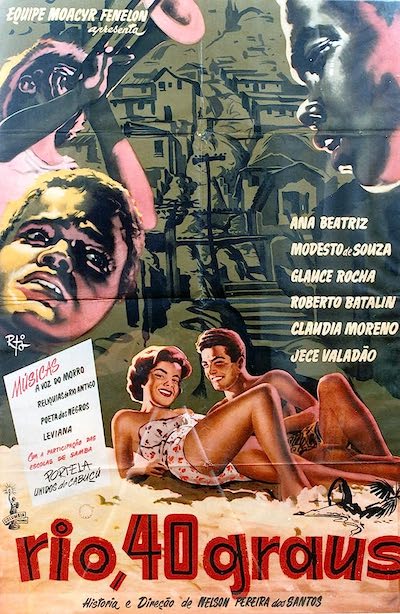
  • Nelson Pereira dos Santos – Rio Quarenta Graus aka Rio 40ºC (1955)

    Drama1951-1960BrazilClassicsNelson Pereira dos Santos

    Banned by Brazil’s Federal Department of Public Safety, “Rio, 40 Grau”s is a landmark film that ushered in the wave of Neorealist cinema in Brazil – Cinema Novo. The film chronicles a day in the life of five peanut vendors from the favelas (shanty towns) of Rio de Janeiro. Other subplots involving characters they meet along the way are interspersed. This was one of the first Brazilian films to address the issues of race, poverty, and class. These themes would continue to be examined by dos Santos throughout his career.Read More »

  • Nelson Pereira dos Santos – Como Era Gostoso o Meu Frances AKA How Tasty Was My Little Frenchman [+Extras] (1971)

    Drama1971-1980BrazilNelson Pereira dos Santos

    THE BEGINNING OF THE EXPLOITATION OF BRAZIL
    In 1594 in Brazil, the Tupinambás Indians are friends of the Frenches and their enemies are the Tupiniquins, friends of the Portugueses. A Frenchman (Arduíno Colassanti) is captured by the Tupinambás, and in spite of his trial to convince them that he is French, they believe he is Portuguese. The Frenchman becomes their slave, and maritally lives with Seboipepe (Ana Maria Magalhães). *Contains Spoilers* Later, he uses powder in the cannons that the Portuguese left behind to defeat the Tupiniquins in a battle. In order to celebrate the victory, the Indians decide to eat him.Read More »

  • Nelson Pereira dos Santos – A Terceira Margem do Rio AKA The Third Bank of the River (1994)

    1991-2000BrazilDramaFantasyNelson Pereira dos Santos

    Free Image Hosting at www.ImageShack.us

    29f7c043f76a2bde437fd0d52a185152

    From the book “Brazilian Cinema” – Edited by Randal Johnson and Robert Stam:

    “The Third Bank of the River” is a coproduction (French and Brazilian) and, like the Guerra film, it too ingeniously interweaves diverses stories by its source author. Beginning with the story that provides the title for the film – the virtually wordless drama of a man who abandons his family to live on a boat in the middle of the river – Nelson Pereira dos Santos integrates four other stories. Liojorge (Ilya São Paulo) the son (in Nelson’s re-creation) of the enigmatic boatman of the first story, follows an enchanted cow and thus becomes the protagonist of another story (“Seqüência”) in which the cow leads him to the most beautiful woman in the world (Sonja Saurin).Read More »

  • Paulo Caldas & Lírio Ferreira – Baile Perfumado AKA Perfumed Ball (1997)

    Drama1991-2000BrazilPaulo Caldas and Lírio Ferreira

    Free Image Hosting at www.ImageShack.us

    29f7c043f76a2bde437fd0d52a185152

    A close friend of “Padre Cicero” (Jofre Soares), the “Lebanese”Mascate” Benjamin Abraham (Duda Mamberti) decides to film “Lampião” (Luis Carlos Vasconcelos) and all his gang, believing that the film will make them rich. After some initial contacts he talks directly with the famous “Cangaceiro” and exposes his idea, but the dreams of “Mascate” are hampered by the dictorship of the Estado Novo.Read More »

  • Lane Slate – Deadly Game (1977)

    1971-1980DramaLane SlateTVUSA

    Free Image Hosting at www.ImageShack.us

    29f7c043f76a2bde437fd0d52a185152

    Plot Synopsis by Hal Erickson

    Twice during the mid-1970s, Andy Griffith unsuccessfully attempted to launch a TV detective series titled Abel Marsh. The first pilot film was The Girl in the Empty Grave; the second was The Deadly Game. Griffith once again stars as resort-town sheriff Abel Marsh, this time wrestling with a sinister conspiracy involving a dangerous chemical spill. Lane Slate produced, directed and wrote the film, while Griffith’s longtime manager Richard O. Linke functioned as executive producer. Deadly Game was first telecast December 3, 1977.Read More »

Back to top button