
A harsh dose of cinematic realism about a harsh time-the Bosnian War of the 1990s-Juanita Wilson’s drama is taken from true stories revealed during the International Criminal Tribunal in The Hague. Samira is a modern schoolteacher in Sarajevo who takes a job in a small country village just as the war is beginning to ramp up. When Serbian soldiers overrun the village, shoot the men and keep the women as laborers (the older ones) and sex objects (the younger ones), Samira is subjected to the basest form of treatment imaginable.Read More »
Drama
-
Juanita Wilson – As If I Am Not There (2010)
2001-2010DramaIrelandJuanita Wilson -
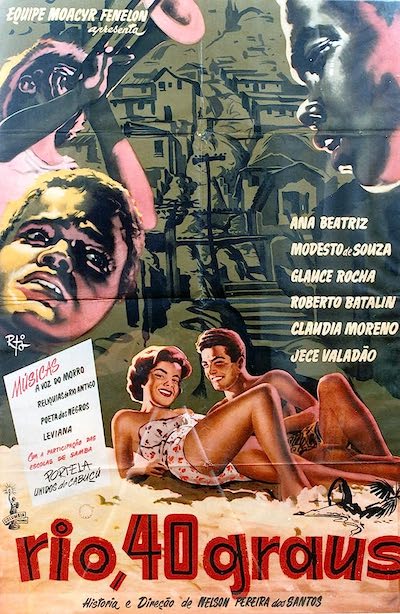
Nelson Pereira dos Santos – Rio Quarenta Graus aka Rio 40ºC (1955)
Drama1951-1960BrazilClassicsNelson Pereira dos Santos

Banned by Brazil’s Federal Department of Public Safety, “Rio, 40 Grau”s is a landmark film that ushered in the wave of Neorealist cinema in Brazil – Cinema Novo. The film chronicles a day in the life of five peanut vendors from the favelas (shanty towns) of Rio de Janeiro. Other subplots involving characters they meet along the way are interspersed. This was one of the first Brazilian films to address the issues of race, poverty, and class. These themes would continue to be examined by dos Santos throughout his career.Read More »
-
Nelson Pereira dos Santos – Como Era Gostoso o Meu Frances AKA How Tasty Was My Little Frenchman [+Extras] (1971)
Drama1971-1980BrazilNelson Pereira dos Santos

THE BEGINNING OF THE EXPLOITATION OF BRAZIL
In 1594 in Brazil, the Tupinambás Indians are friends of the Frenches and their enemies are the Tupiniquins, friends of the Portugueses. A Frenchman (Arduíno Colassanti) is captured by the Tupinambás, and in spite of his trial to convince them that he is French, they believe he is Portuguese. The Frenchman becomes their slave, and maritally lives with Seboipepe (Ana Maria Magalhães). *Contains Spoilers* Later, he uses powder in the cannons that the Portuguese left behind to defeat the Tupiniquins in a battle. In order to celebrate the victory, the Indians decide to eat him.Read More » -
Nelson Pereira dos Santos – A Terceira Margem do Rio AKA The Third Bank of the River (1994)
1991-2000BrazilDramaFantasyNelson Pereira dos SantosFrom the book “Brazilian Cinema” – Edited by Randal Johnson and Robert Stam:
“The Third Bank of the River” is a coproduction (French and Brazilian) and, like the Guerra film, it too ingeniously interweaves diverses stories by its source author. Beginning with the story that provides the title for the film – the virtually wordless drama of a man who abandons his family to live on a boat in the middle of the river – Nelson Pereira dos Santos integrates four other stories. Liojorge (Ilya São Paulo) the son (in Nelson’s re-creation) of the enigmatic boatman of the first story, follows an enchanted cow and thus becomes the protagonist of another story (“Seqüência”) in which the cow leads him to the most beautiful woman in the world (Sonja Saurin).Read More »
-
Paulo Caldas & Lírio Ferreira – Baile Perfumado AKA Perfumed Ball (1997)
Drama1991-2000BrazilPaulo Caldas and Lírio FerreiraA close friend of “Padre Cicero” (Jofre Soares), the “Lebanese”Mascate” Benjamin Abraham (Duda Mamberti) decides to film “Lampião” (Luis Carlos Vasconcelos) and all his gang, believing that the film will make them rich. After some initial contacts he talks directly with the famous “Cangaceiro” and exposes his idea, but the dreams of “Mascate” are hampered by the dictorship of the Estado Novo.Read More »
-
Lane Slate – Deadly Game (1977)
1971-1980DramaLane SlateTVUSAPlot Synopsis by Hal Erickson
Twice during the mid-1970s, Andy Griffith unsuccessfully attempted to launch a TV detective series titled Abel Marsh. The first pilot film was The Girl in the Empty Grave; the second was The Deadly Game. Griffith once again stars as resort-town sheriff Abel Marsh, this time wrestling with a sinister conspiracy involving a dangerous chemical spill. Lane Slate produced, directed and wrote the film, while Griffith’s longtime manager Richard O. Linke functioned as executive producer. Deadly Game was first telecast December 3, 1977.Read More »
-
Stanley Kramer – Judgment at Nuremberg (1961)
1961-1970ClassicsDramaStanley KramerUSAThis movie is a fictionalized account of the war crimes trial of judges and prosecutors who served the Nazis.
“Judgment at Nuremberg” depicts a watershed event: the first trials, based on principles of justice and international law, of the leaders of a country that waged aggressive war and committed crimes against humanity. The film is a gripping, searching and provocative look at the moral issues surrounding both the actions of the accused and the process of bringing them to justice. The film also explores the issue of whether ordinary Germans bore responsibility for the Holocaust.Read More » -
Stanley Kramer – On the Beach (1959)
1951-1960DramaStanley KramerUSAWarIn 1964, nuclear war wipes out humanity in the northern hemisphere; one American submarine finds temporary safe haven in Australia, where life-as-usual covers growing despair. In denial about the loss of his wife and children in the holocaust, American Captain Towers meets careworn but gorgeous Moira Davidson, who begins to fall for him. The sub returns after reconnaissance a month (or less) before the end; will Towers and Moira find comfort with each other?Read More »
-
William K. Howard – The Valiant (1929)
1921-1930DramaUSAWilliam K. HowardPaul Muni’s film debut. Muni earned an Academy Award nomination for his performance, the first of six in his long career.
A drifter with a clouded past accidentally kills the key witness to a crime, then sacrifices himself to the law under an assumed name rather than disgrace his family. In this manner, Muni is certain that he’s redeemed himself for his previous misdeeds–but a curious police inspector tries to probe his past. The Valiant was remade in 1940 as THE MAN WHO WOULDN’T TALK, with Lloyd Nolan in the Muni role.Read More »


