An enigmatic and decadent white diplomat arrives in central Africa sporting dark glasses, riding boots, and a cigarette holder. He has recently bought an ambassadorship and claims to be a do-good rich businessman spearheading a diplomatic mission. Officially, he is there to start a factory that will employ locals to produce matches. Unofficially, he has really come to gain access to the area’s vast reserves of diamonds. It soon becomes apparent that, in this postcolonial economy, nearly everyone is out to rip off everyone else, and the dangers become all too real.Read More »
Quote:
In this extraordinary six-part series, film historian and critic Noel Burch uses clips of rare archival silent film treasures to take us on a riveting journey of discovery. How did silent film reach such incredible heights in a mere 30 years? Why did film in the United States so quickly become such a popular art form?
In the first program, Along the Great Divide: Great Britain 1900-1912, Burch examines early British classics like Rescued by Rover and other, rare films by Cecil Hepworth, Stuart Kinder, James Williamson, R.W. Paul and others to look at how the British “gentlemen inventors of the cinema” created entertainment for the poor.
The second part, Tomorrow the World: USA 1902-1914, looks at early film in America against the background of the immigrant masses streaming into the factories, slums and sweat-ships of early 20th century America. Films by Porter, Griffith, Reginald Baker, George Dobson, Stuart Blackton and others show how early American film invented social content and then dropped it for the development of narrative.
In the third program, She! Denmark 1902-1914, Burch looks at the incredible explosion of filmmaking in Denmark where mature cinema was born at a time when French and American films were simple melodramas. The earliest Danish film stars – Asta Nielsen and Urban Gad – played in remarkable films which were innovative in the technical aspects of lighting, camera angles and editing.Read More »
The 1965 Tour de France was won by a young Italian called Felice Gimondi, riding only as a late inclusion. The French had hoped that the winner would be Raymond Poulidor relieved for once of riding against Jacques Anquetil who had always beaten him. By the Chartreuse, however, Gimondi was unbeatable and even attacked Poulidor and left him behind “just to show Raymond that I could go faster and that I was the better man.”Read More »
The 70’s was a period in Australian Rock Music when the industry’s top acts could also be seen at the annual Sunbury Music Festival. On each Australia Day Weekend from 1972-1975, crowds of 35,000 or more would camp at the picturesque site 30 minutes from Melbourne, anticipating a full rocking of their socks from Australia’s own rock’n’roll icons. But the very first Sunbury – an all Australian affair showcasing the talents of the day – is the most fondly remembered by those that made the pilgrimage. Where else could you see Chain, Lobby Loyde and Max Merrit on the same bill? And where else but Sunbury would Billy Thorpe and the Aztecs debut ‘Most People I Know Think That I’m Crazy’? In 1972 – post Woodstock but years before The Big Day Out, Sunbury was an event not to be missed. This film serves as a reminder of that first festival in 1972, and captures the spirit of Sunbury’s ethos – “”to have a good time””. So join your host Molly Meldrum – dressed in the style of the times – and sit back, relax, crank up the volume, and stroll down memory lane to Sunbury. Read More »
Content:
It is about the members of the “Partisan” organization for physical education doing gymnastics. Reception and accompaniment of Tito’s (estafette?) baton is also presented.
Movie from 1953, in duration of 11 minutes.
The movie is created in standard technique, with sound, in black and white Read More »
In 1979, while making his epochal Holocaust film, “Shoah,” Claude Lanzmann filmed this interview with Maurice Rossel, a Red Cross doctor from Switzerland who, having visited Auschwitz and Theresienstadt in 1944, gave the latter a highly favorable report. Lanzmann questions Rossel insistently about the deceptions that the Germans forced the Jewish inmates of Theresienstadt to perpetrate for Rossel’s benefit—which fooled the doctor completely. Lanzmann culminates his interview by reading a speech with which the Jewish “mayor” of the concentration camp had welcomed Rossel, which, though vague enough to pass unnoticed by the German captors, resounds unambiguously as a thinly veiled cry for help—and an exhortation to Rossel to not be deceived by appearances. Rossel is easy to despise and easier to mock, but the cold light of his detachment serves as a reminder of the tyrannical deceits that, even now, conceal atrocities. Released in 1997.Read More »
Sterile practice
7 August 2010 | by oOgiandujaOo (United Kingdom)
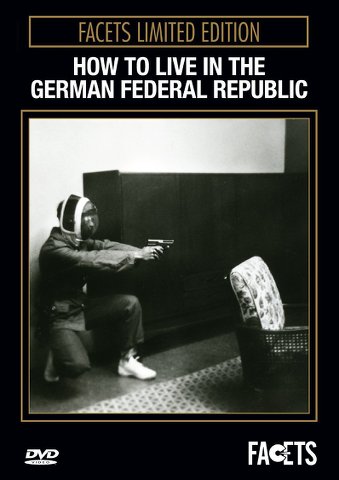
My only previous experience of Farocki prior to watching Leben – BRD (How to live in the FRG) was Die Bewerbung (The Interview). The subject of that documentary film was the preparing of people who had difficulty finding work for job interviews. The movie highlighted how unnatural it was to be in a situation where you had to sell yourself (the training provides promotion of an unnatural self-awareness), where you have to project a compliant image for the Procrustean corporate scrutiniser. Leben – BRD expands on this limited scenario to provide a number of training scenarios. This includes training people to kill, provide obstetric care, separate those involved in domestic arguments etc. All this is interspersed with factory images of equipment being tested for longevity (for example a car door being opened and closed a thousand times by machine). It all comes off as quite banal and sterile programming. There is no room for personality, there is no room for personal connection. I’ve heard how feeling is something that has been outsourced to professionals (psychiatrists), here the psychiatrists are just as impersonal, running a child through a quick-march battery of standardised tests, getting a patient to draw a time series graph of the progression of their phobia, incapable of providing what the patient needs, a shoulder to cry on, someone to hug and understand.Read More »
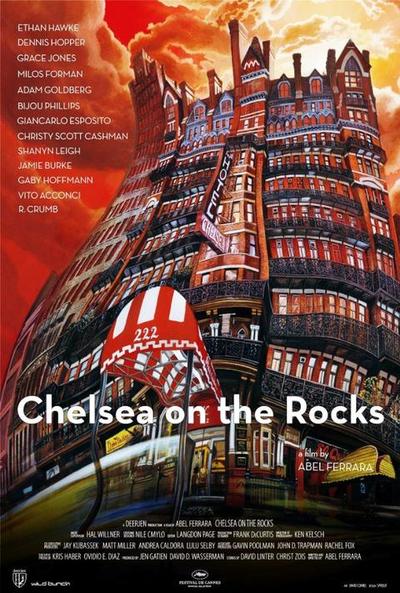
The Chelsea Hotel has long been considered the creative epicentre of New York City, a sort of unofficial gathering point for the most renowned artists and entertainers that the city has to offer. But while the Chelsea Hotel was once thought an impenetrable, untouchable monument to the creative spirit, an early 21st century renovation led many to believe that the new management company had little appreciation for its unique history. Dennis Hopper, Milos Forman, Robert Crumb, Ethan Hawke, Grace Jones, and a whole host of Chelsea Hotel regulars all chime in with their fondest memories about the New York landmark, and their thoughts about what may be in store for the iconic building in the future.Read More »