Documentary

  • Claude Lelouch – …pour un maillot jaune AKA For a Yellow Jersey (1965)

    1961-1970Claude LelouchDocumentaryFranceShort Film

    29f7c043f76a2bde437fd0d52a185152

    The 1965 Tour de France was won by a young Italian called Felice Gimondi, riding only as a late inclusion. The French had hoped that the winner would be Raymond Poulidor relieved for once of riding against Jacques Anquetil who had always beaten him. By the Chartreuse, however, Gimondi was unbeatable and even attacked Poulidor and left him behind “just to show Raymond that I could go faster and that I was the better man.”Read More »

  • John Dixon – Sunbury Rock Festival (1972)

    1971-1980AustraliaDocumentaryJohn DixonMusical


    29f7c043f76a2bde437fd0d52a185152

    The 70’s was a period in Australian Rock Music when the industry’s top acts could also be seen at the annual Sunbury Music Festival. On each Australia Day Weekend from 1972-1975, crowds of 35,000 or more would camp at the picturesque site 30 minutes from Melbourne, anticipating a full rocking of their socks from Australia’s own rock’n’roll icons. But the very first Sunbury – an all Australian affair showcasing the talents of the day – is the most fondly remembered by those that made the pilgrimage. Where else could you see Chain, Lobby Loyde and Max Merrit on the same bill? And where else but Sunbury would Billy Thorpe and the Aztecs debut ‘Most People I Know Think That I’m Crazy’? In 1972 – post Woodstock but years before The Big Day Out, Sunbury was an event not to be missed. This film serves as a reminder of that first festival in 1972, and captures the spirit of Sunbury’s ethos – “”to have a good time””. So join your host Molly Meldrum – dressed in the style of the times – and sit back, relax, crank up the volume, and stroll down memory lane to Sunbury.
    Read More »

  • Aco Petrovski – Partisan (1953)

    1951-1960Aco PetrovskiDocumentaryMacedoniaYugoslavian Cinema under Tito

    Content:
    It is about the members of the “Partisan” organization for physical education doing gymnastics. Reception and accompaniment of Tito’s (estafette?) baton is also presented.

    Movie from 1953, in duration of 11 minutes.
    The movie is created in standard technique, with sound, in black and white
    Read More »

  • Claude Lanzmann – Un vivant qui passe AKA A Visitor from the Living (1997)

    1991-2000Claude LanzmannDocumentaryFrancePolitics

    http://img689.imageshack.us/img689/3128/unvivantquipasse2589648.jpg

    29f7c043f76a2bde437fd0d52a185152

    In 1979, while making his epochal Holocaust film, “Shoah,” Claude Lanzmann filmed this interview with Maurice Rossel, a Red Cross doctor from Switzerland who, having visited Auschwitz and Theresienstadt in 1944, gave the latter a highly favorable report. Lanzmann questions Rossel insistently about the deceptions that the Germans forced the Jewish inmates of Theresienstadt to perpetrate for Rossel’s benefit—which fooled the doctor completely. Lanzmann culminates his interview by reading a speech with which the Jewish “mayor” of the concentration camp had welcomed Rossel, which, though vague enough to pass unnoticed by the German captors, resounds unambiguously as a thinly veiled cry for help—and an exhortation to Rossel to not be deceived by appearances. Rossel is easy to despise and easier to mock, but the cold light of his detachment serves as a reminder of the tyrannical deceits that, even now, conceal atrocities. Released in 1997.Read More »

  • Alexander Kluge – News From Ideological Antiquity Marx-Eisenstein-Capital [Theatrical Cut] (2010)

    Documentary2001-2010Alexander KlugeGermany

    29f7c043f76a2bde437fd0d52a185152

    Quote:
    It’s settled: we’re going to film CAPITAL on Marx’s scenario–the only logical solution.
    –Sergei Eisenstein, Oct 12, 1927.

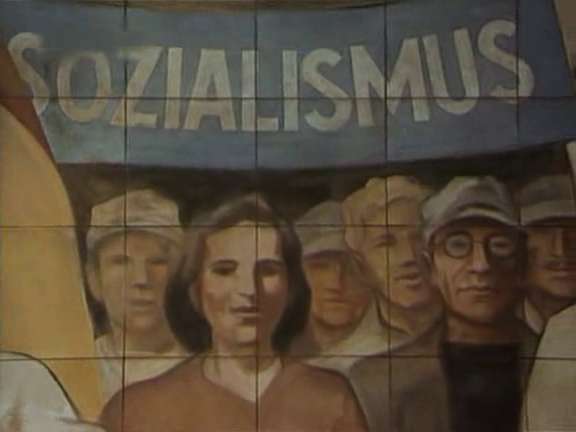
    This is an English subtitled copy of the ‘theatrical’ or ‘cinema’ version of Alexander Kluge’s Nachrichten aus der ideologischen Antike: Marx – Eisenstein – Das Kapital or News From Ideological Antiquity: Marx – Eisenstein – Capital. The original work made for broadcast or DVD was finished in 2008 and ran 570 minutes long. This 84 minute cut prepared by Kluge for exhibition condenses this mammoth project into something like a digestible greatest hits or highlight reel. Kluge’s film is a discursive essay about and around Eisenstein’s notes on a film of Marx’s Capital–written shortly after the release of OCTOBER in 1927 and connected to his ideas for conceiving a film of Joyce’s ULYSSES. According to Helmet Merker writing on the 570 minute version, “Eighty years on, Alexander Kluge joins the party and takes up where Eisenstein failed, because neither Hollywood’s capitalists nor Moscow’s Communists were prepared to send the necessary funds his way… Scholarly stuff, wide and deep in scope, yet bold and playful. But even if your own study of Marx is no more than a faded memory, it is hugely enjoyable to watch and listen to these experts… Alexander Kluge is a great manipulator, an industrious loom, who weaves the most far-flung observations into his system. He is not filming “Das Kapital” but researching how one might find images to make Marx’s book filmable. The quest is the way is the destination… In Kluge’s hands this becomes a collage of documentary, essayistic and fictional scenes, interviews and still photos, archive images of smoking factory chimneys, time-lapse footage of pounding machines and mountains of products, diary entries and blackboards scribbled with quotes referencing constructivism and concrete poetry… Unlike Eisenstein, who was driven to desperation by the herculean task of cutting the 29 hours of “October” into a 90-minute film version and turned to drugs into the process which left him temporarily blind, Kluge cooly sticks to his guns and his nine hours. And it’s not a minute too long.”
    Kluge may have stuck to his guns but he also offered another option.

    Embedded in this film is a short film by Tom Tykwer called THE INSIDE OF THINGS
    Read More »

  • Harun Farocki – Leben – BRD AKA How to Live in the German Federal Republic (1990)

    Documentary1981-1990ArthouseGermanyHarun Farocki

    29f7c043f76a2bde437fd0d52a185152

    Sterile practice
    7 August 2010 | by oOgiandujaOo (United Kingdom)

    My only previous experience of Farocki prior to watching Leben – BRD (How to live in the FRG) was Die Bewerbung (The Interview). The subject of that documentary film was the preparing of people who had difficulty finding work for job interviews. The movie highlighted how unnatural it was to be in a situation where you had to sell yourself (the training provides promotion of an unnatural self-awareness), where you have to project a compliant image for the Procrustean corporate scrutiniser. Leben – BRD expands on this limited scenario to provide a number of training scenarios. This includes training people to kill, provide obstetric care, separate those involved in domestic arguments etc. All this is interspersed with factory images of equipment being tested for longevity (for example a car door being opened and closed a thousand times by machine). It all comes off as quite banal and sterile programming. There is no room for personality, there is no room for personal connection. I’ve heard how feeling is something that has been outsourced to professionals (psychiatrists), here the psychiatrists are just as impersonal, running a child through a quick-march battery of standardised tests, getting a patient to draw a time series graph of the progression of their phobia, incapable of providing what the patient needs, a shoulder to cry on, someone to hug and understand.Read More »

  • Andy Harries – The Incredibly Strange Film Show: Fred Olen Ray & Doris Wishman (1988)

    1981-1990Andy HarriesDocumentaryDoris WishmanFred Olen RayUSA

    Read More »

  • Abel Ferrara – Chelsea on the Rocks (2008)

    2001-2010Abel FerraraArthouseDocumentaryUSA

    The Chelsea Hotel has long been considered the creative epicentre of New York City, a sort of unofficial gathering point for the most renowned artists and entertainers that the city has to offer. But while the Chelsea Hotel was once thought an impenetrable, untouchable monument to the creative spirit, an early 21st century renovation led many to believe that the new management company had little appreciation for its unique history. Dennis Hopper, Milos Forman, Robert Crumb, Ethan Hawke, Grace Jones, and a whole host of Chelsea Hotel regulars all chime in with their fondest memories about the New York landmark, and their thoughts about what may be in store for the iconic building in the future.Read More »

  • Wim Wenders – Aufzeichnungen zu Kleidern und Städten AKA A Notebook on Clothes and Cities (1989)

    1981-1990ArthouseDocumentaryGermanyWim Wenders

    From tankmagazine
    “Fashion, I’ll have nothing of it,” announces Wim Wenders in the opening to his 1990 fashion documentary Notebook on Cities and Clothes. It was the year after the Berlin Wall fell, and there is a sense in his introduction, of the German film-maker defending a subject his critics might view as superficial. In a voiceover, Wenders explains that he had been invited to make a short film about the fashion industry by the Centre Pompidou. And while initially dismissive, he found that the idea grew on him – “After all, why not examine fashion… Maybe fashion and cinema had something in common.”Read More »

Back to top button