

The village artist Jangarh Singh Shyam left home and became a well-known contemporary painter. He committed suicide in 2001. Through his art, places and stories, the filmmaker explores the traces he left on his path.Read More »
The village artist Jangarh Singh Shyam left home and became a well-known contemporary painter. He committed suicide in 2001. Through his art, places and stories, the filmmaker explores the traces he left on his path.Read More »
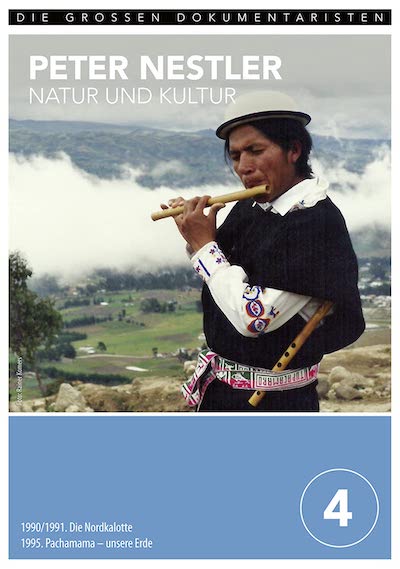
Pachamama is another fine example of Peter Nestler’s extraordinary documentaries. He takes us on an expedition to Ecuador, to the heart of an ancient Indian culture. Although heavily damaged by the Spanish conquerors, many of the old treasures and, more remarkably, many of the old traditions and customs have survived and are still in practice today. It’s a film of quiet beauty and sadness, but of a sadness that is friendly and not bitter; a film about the cultural wealth of a fascinating country. (Ted Roth, -viennale.at)Read More »

Radically ahead of its time in its candor and compassion, this groundbreaking documentary follows a group of transgender individuals struggling to make their way in every strata of 1980s America. From finding employment to finding acceptance, WHAT SEX AM I? gives empathetic voice to the everyday challenges faced by trans people decades before issues of gender identity were widely discussed in the mainstream.Read More »

The life of Jean Seberg, through unpublished testimonies: her son, Diego Gary, her sister Mary Ann, Clint Eastwood, who was her partner. The American actress, the iconic short-haired girl from A bout de souffle, reveals herself to be a passionate, militant, but also secretive and fragile woman. Her tragic ending contributes to her almost mythical aura.Read More »

Quote:
A film showing the social mood and tensions in the period between the end of the strikes in August 1980 and the registration of the Solidarity Trade Union in November 1980.
The film won awards, among others:
1981 – Kraków (Kraków Film Festival – Polish Competition; until 2000 National Short Film Festival) – “Bronze Lajkonik” Award in the documentary film category for Bohdan KosińskiRead More »

In this personal documentary, Jane Giese, a working class woman in Newark, comes to realize that she has to take control of her own life after years of physical and mental abuse.
One of the most moving documentaries of the era, Newsreel’s Janie’s Janie breaks with their usual format for a more personal approach, following one woman’s journey to self-determination, or as Janie says, “First I was my father’s Janie, then I was my Charlie’s Janie, now I’m Janie’s Janie.”Read More »

IMDb User wrote:
This correspondence, or exchange of letters and video diaries between acclaimed filmmakers Jonas Mekas and José Luis Guerin is extremely potent, there’s sorcery at play in the mixture of the two. Together they’re light and dark. Mekas knows life’s joys, and is always a participant in what he films, Guerín is a detached observer, cold, present only as a black mote, reflected in the eye of one of his subjects. Guerín shoots in black and white and strives for formalism, Mekas loves hazard, loves his chaotic hand-held colour camera. Jonas Mekas felt that his images were inferior to those of Guerín, but a picture of his son Sebastian devouring a pickle, followed by Jonas on the deli sausage and wine, and then a cheeky close up of Goethe’s Faust; which of them Faust and which Mephistopheles? That one shot set me thinking about the nature of art and the privilege of artists, and could be interpreted in any one of several fruitful ways.Read More »

The installation THE SILVER AND THE CROSS by media artist Harun Farocki examines the 1758 painting “Depiction of the Cerro Rico and the Imperial City of Potosí” by Gaspar Miguel des Berrío (in the Museo Colonial Charcas de la Universidad San Francisco Xavier, Sucre, Bolivia). Farocki uses the medium of video to dissect the painting and its historical layers. In addition to artistic aspects, Farocki also looks at historical context and colonialism.Read More »

Quote:
Bouche sans fond ouverte sur les horizons (1971, 26′)
In 1971 Thierry Zéno creates a fascinating portrait of artist Georges Moinet in the form of a 16 mm medium-length film. A schizophrenic who lives in a psychiatric hospital near Namur, Moinet paints. After being mute for 24 years he chooses this cinematic encounter to explain his artist approach, revealing what lies behind his personal cosmogony. But this long logorrhoea proves disturbing and fails to provide possible clues to understanding his work, gradually becoming a form of music that blends in with the sounds and distant, invisible hubbub of the hospital. With Alessandro Ussai behind the camera and Roger Cambier responsible for the sound, Zéno gets up close to Moinet to better capture him in all his demiurgical excessiveness, his existence on the fringes but also his humanity, deconstructing in a series of very tight shots the man and his canvasses.Read More »