Quote: A historical socio-political depiction of the development of Chile since the 16th century and until the coup d’etat. The country’s dependancy on foreign capital is made clear as well as the strength of the bourgeoisie in comparison to other third world countries. The film mainly consists of still images. Filmcentrum catalouge no 23Read More »
1956 proved to be a crucial year in Lindsay Anderson’s career. Not only did he initiate the first Free Cinema screening, but he also wrote one of his most passionate theoretical pieces, “Stand Up! Stand Up!” (Sight and Sound, Autumn 1956), and he started the production of his new film, Every Day Except Christmas.Read More »
Quote: Jean-François, Ronald, Alexis, Cédric, Benoit and Maxim are gladiators of modern times. From the strongman to the top-class bodybuilder, to the veteran who has become a trainer, they all share the same definition and obsession with overcoming their limitations. They are waiting for the next competition, working hard in the gym and following extreme diets.Read More »
Quote: Award-winning director Fatih Akin takes us on a journey through Istanbul, the city that bridges Europe and Asia, and challenges familiar notions of east and west. He looks at the vibrant musical scene which includes traditional Turkish music plus rock and hip-hop.Read More »
Upon his departure from his home in Baguio, the road trip of the director’s youngest son, Kabunyan, begins. He stops at certain places along the way, engaging in conversation with various companions – often artists – in between drives.Read More »
In the midst of the ever-fraught Israeli-Palestinian political landscape, two women, one Israeli and one Palestinian, attempt the seemingly impossible: to build a business together. Fighting against societal and family pressure, anti-normalization currents and a chauvinistic, male-dominated industry, the two combine forces to create a logistics company which helps Palestinian businessmen to navigate the everyday absurdities of Israeli control of the West Bank. But while they help their clients to overcome the obstacles of Israeli occupation, the divisions between them threaten to tear their partnership apart. Can the bond between them overcome the impossible?Read More »
Echo of the Mountain presents a look into the life and work of Santos de la Torre, a great Huichol artist who, like his people, lives in oblivion. Ironically, one of Santos’ murals was selected by then-President Ernesto Zedillo to represent Mexican culture in a privileged location in Paris. The artist was never paid for his work. We will follow Santos during his pilgrimage to Wirikuta, where he will ask the gods’ for permission to create a new mural. This new mural will portray the history, mythology, and religious practices of the Huichol people. We will take the audience on a journey across 385 miles of the “Peyote Route,” which is in danger of disappearing unless it receives the protection of UNESCO. Written by Echo of the MountainRead More »
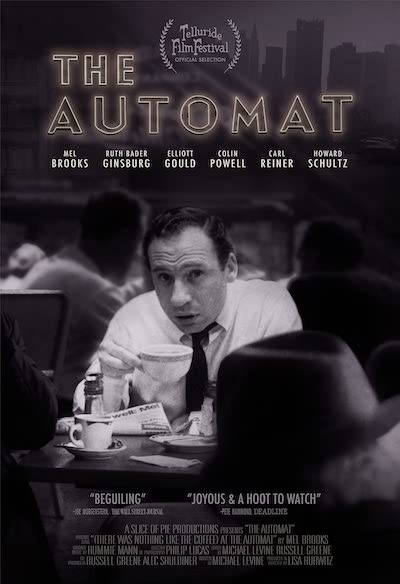
Quote: Before fast food we had something better. Our grandparents told us stories of gathering around communal tables, sharing their lives, their struggles, and their dreams with strangers at The Automat. In the long awaited Horn & Hardart documentary relive the phenomena of America’s original and most beloved restaurant chain. The one hundred year Automat saga serves up never before-seen archival footage and photographs and a cast including celebrity customers, company executives, historians, and members of the Horn & Hardart families.Read More »
In 2009, in a small theater in Geneva, Switzerland, the film directors Marcel Ophuls and Jean-Luc Godard met for an unusual, surprisngly intimate and sometimes contentious dialogue with each other in front of a live audience. Luckily for us, it was filmedRead More »