Classics

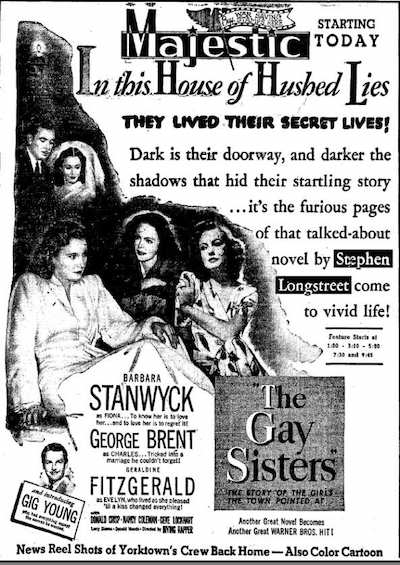
  • Irving Rapper – The Gay Sisters (1942)

    Irving Rapper1941-1950ClassicsDramaUSA

    THE SCREEN IN REVIEW; ‘ The Gay Sisters,’ Featuring Barbara Stanwyck, George Brent, Geraldine Fitzgerald and Donald Crisp, at Strand
    T. S.
    Published: August 15, 1942
    The New York Times

    What a long, gray and pretentious film “The Gay Sisters” is! Another pointlessly caustic inquiry into the lives of the eccentric off-spring of a once grand family, the new film at the Strand not once offers the slightest reason to warrant the telling of its involved and trivial story. Read More »

  • Max Ophüls – Sans lendemain AKA There’s No Tomorrow AKA Without Tomorrow (1939)

    Max Ophüls1931-1940ClassicsDramaFrance

    Synopsis:
    The story of a once-respectable woman who re-encounters her first love, now a successful doctor. Reduced to nude-dancing in a sleazy dive, with a son to support, Evelyne (Edwige Feuillère) borrows money at an outrageous interest rate in order to create a facade of respectability–and, it goes without saying, Georges falls in love with her all over again. But how can Evelyne maintain her bourgeois value and save son and “father” from the consequences of her fall?Read More »

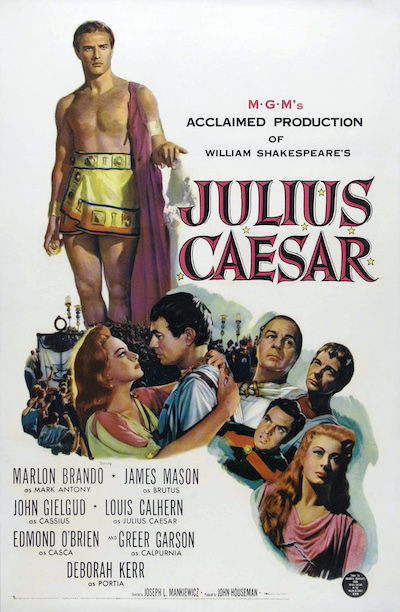
  • Joseph L. Mankiewicz – Julius Caesar (1953)

    Joseph L. Mankiewicz1951-1960ClassicsPoliticsUSAWilliam Shakespeare

    Synopsis:
    Brutus is convinced by a scheming band of Roman senators, led by Caius Cassius, that his dear friend Julius Caesar intends to dissolve the republic and install himself as monarch, and he joins a conspiracy to assassinate him. Brutus stirringly defends his actions, but when Mark Antony responds with a speech that plays upon the crowd’s love for their fallen leader, a battle between the two factions is assured.Read More »

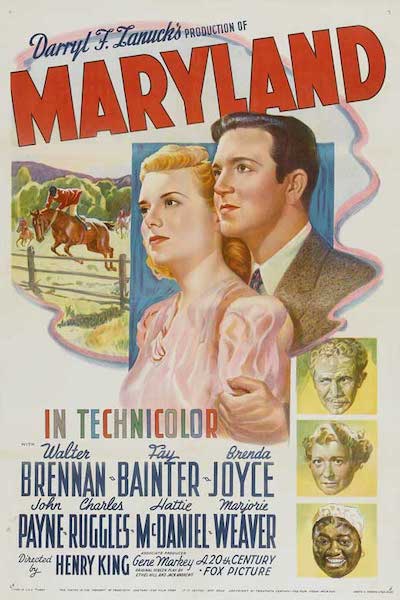
  • Henry King – Maryland (1940)

    Henry King1931-1940ClassicsDramaUSA

    Synopsis: Charlotte Danfield (Fay Bainter), a member of an old Maryland family with horse breeding in its blood, orders her entire stable sold after her husband meets his death in a hunting accident. She also forbids her son Lee (John Payne) to ride again, but when the boy remains friendly with Charlotte’s old horse trainer, William Stewart (Walter Brennan), and his granddaugther Linda (Brenda Joyce), Charlotte ships him off to school in Europe to remove him from Maryland’s horse-oriented environment. Horses are in Lee’s blood, however, so when he returns home a grown man and learns that “Uncle Bill” is grooming “Cavalier” for the Maryland Cup, he eagerly offers to ride the steed. Later, after acquiescing to Charlotte’s wish that he not ride, Lee, out of a sense of loyalty to Uncle Bill, defies his mother’s will. Read More »

  • Hiroshi Shimizu – Joi no kiroku AKA Record of a Woman Doctor (1941)

    Hiroshi Shimizu1941-1950ClassicsDramaJapan

    A group of female doctors travel to a remote village during their summer holiday to offer free medical care to villagers. There they must battle prejudice and superstition as much as disease. Stars Kinuyo Tanaka and Shin Saburi.Read More »

  • Kôzaburô Yoshimura – Yoru no chô AKA Night Butterflies (1957)

    Kôzaburô Yoshimura1951-1960ClassicsDramaJapan

    Synopsis:
    As Japan became more prosperous, the Ginza district of Tokyo emerged as the luxury bar and cabaret center it remains to this day. While the charming and beautiful women who operate these establishments are privy to political and financial deals of national importance, Yoshimura’s film reveals that their hopes, their businesses and their very lives are as fragile as butterflies.Read More »

  • Nobuo Aoyagi – Ai no sekai: Yamaneko Tomi no hanashi AKA World of Love (1943)

    1941-1950AsianClassicsJapanNobuo Aoyagi

    16 year old orphan Tomi (played by Hideko Takamine) was a wild and unsettled girl. The juvenile court punishes her to be sent into the mountains of Aoyama for reeducation. Here she is taken care of by the teacher Miss Yamada, which is kind but has troubles getting along with the girls that are sent to her…
    The director Aoyagi, wo directed a number of entertainment films during the war, deals with the topic of punishment and problematic youngsters. The film is very different and much more dramatic from films by Hiroshi Shimizu or Hiroshi Inagaki dealing with similar topic. The film depicts the roughness of the young girls and the brutality amongst them in a more realistic way. He takes a rare approach by not having Tomi say anything at all during the first half of the film. The film is also interesting from a historical point of view in putting the focus on the attitude of the Japanese state towards problematic young people during the war.Read More »

  • Vittorio Cottafavi – I persiani (1975)

    1971-1980ClassicsItalyTVVittorio Cottafavi

    Cottafavi’s adaptation of Aeschylus’ play.

    Michael Billington wrote:
    The Persians is the oldest surviving work of Western drama. First performed at the City Dionysia in 472 BC, The Persians takes a nuanced approach to the matter of war and conquest. It was a direct inspiration for the French national anthem, ‘La Marseillaise’. Percy Shelley’s drama Hellas was written in response to it. It’s the only play from the classical era that deals with historical events rather than mythological ones. In short, The Persians is a fascinating play and Aeschylus’ handling of war is worthy of closer inspection and analysis.Read More »

  • Tai Kato – Jinsei gekijô – Seishun aiyoku zankyohen aka Theater of LIfe: Youth, Lust and Spirit (1972)

    Tai Katô1971-1980AsianClassicsJapan

    Quote:
    Few novels were filmed as many times as Shiro Ozaki’s famous Theatre of Life . So rich and appealing is this roman fleuve about chivalrous yakuza that, over the decades, it was rendered in “youth”and animated versions, as a lavish epic or omnibus film (including one by Kinji Fukasaku), and indeed was initially made by Uchida in 1936 as a highly regarded “social tendency” film. But Uchida’s later version is considered the gold standard, partly because of his mastery at visual storytelling, partly because of his superb ensemble cast. The yakuza Hishakaku kills someone in a dispute over a barmaid, but turns himself in at the urging of Kiratsune, an old gangster who has just returned from eight years in Shanghai and has become his protector.When he gets out of prison, Hishakaku finds himself once again torn between his sense of duty to his gang and his sense of humanity, and is drawn back into the bloody clan feuds.Read More »

Back to top button