PLOT OUTLINE :
A non-linear surrealistic horror film documenting a man’s broken descent into isolation, body mutilation, paedophilia and murder.Read More »

PLOT OUTLINE :
A non-linear surrealistic horror film documenting a man’s broken descent into isolation, body mutilation, paedophilia and murder.Read More »


In this often very funny enquiry into crankiness, Toronto filmmaker Alan Zweig interviews notable curmudgeons like Fran Lebowitz, Harvey Pekar and Bruce LaBruce. Zweig wants to know what their frickin’ problem is and, more importantly, whether it’s the same as his. As in Vinyl, his equally irascible doc on record collectors, the endearingly dour filmmaker spends much of I, Curmudgeon spilling his guts directly to his camera and torturing himself with big questions that he can never answer satisfactorily. Zweig then confronts his subjects with the same questions, thereby making them even grouchier. (How grouchy? Andy Rooney is moved to kick Zweig out of his office.) Though I, Curmudgeon’s meandering structure and incessant jump-cuts are irritants, they’re also appropriate to the movie’s abrasive, anti-social personality. Consider this a testament to the power of negative thinking. – Eye WeeklyRead More »


Benoit and Maryse: a brother and sister with seemingly normal lives. Everything is changed by a series of coincidences… and the arrival of a man claiming to come from the future.Read More »

At some point, everyone has asked the question, why is it so hard to find love? In this final installment of the autobiographical trilogy that includes Vinyl and I, Curmudgeon, Alan Zweig reflects with disarming candour on why, if he longs for a partner and children, he is still single at mid-life.Read More »
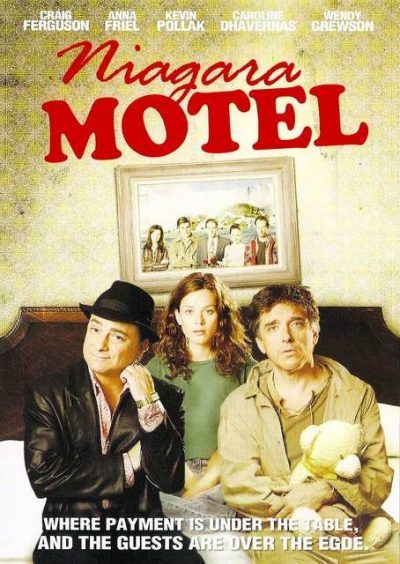
Niagara Motel is a 2006 Canadian drama film directed by Gary Yates. The film earned numerous nominations, including a Genie Award for Best Supporting Actress for Caroline Dhavernas.
Niagara Motel features its namesake and the ongoings amongst the inhabitants of the motel located in Niagara Falls. The characters include a knockout waitress (Caroline Dhavernas) being recruited to star in low budget porn videos, a young couple with a criminal past struggling to recover their child from social services, and a middle class husband and wife in a marriage that is disintegrating in near record time all led by a drunken motel caretaker.Read More »

David Cronenberg’s adaptation of Christopher Hampton’s play detailing the deteriorating relationship between Sigmund Freud and Carl Jung as they contend with a particularly troubled patient. The year is 1904. Carl Jung, a disciple of Sigmund Freud, is using Freudian techniques to treat Russian-Jewish psychiatric patient Sabina Spielrein at Burghölzli Mental Hospital. But the deeper Jung’s relationship with Spielrein grows, the further the burgeoning psychiatrist and his highly respected mentor drift apart. (~blu-ray.com)Read More »


Synopsis:
Forty-something Quebeçois Philippe Roberge is floundering in his life. He believes that no one listens to him or takes him seriously. A graduate student in Philosophy of Scientific Culture, he has just failed his Ph.D. dissertation for the second time, his theory of interest in outer space being a narcissistic response from man being widely rejected throughout the community. To make ends meet, he works selling newspaper subscriptions. And he has a cordial but basically non-existent relationship with his ex-wife. Philippe examines his life in response to the recent death of his mother coupled with his dissertation beliefs. Although she lived in a care home, he acted as her primary caregiver.Read More »

Somewhere in Sub-Saharan Africa, Komona a 14-year-old girl tells her unborn child growing inside her the story of her life since she has been at war. Everything started when she was abducted by the rebel army at the age of 12.Read More »


Quote:
«La Région Centrale» was made during five days of shooting on a deserted mountain top in North Quebec. During the shooting, the vertical and horizontal alignment as well as the tracking speed were all determined by the camera’s settings. Anchored to a tripod, the camera turned a complete 360 degrees, craned itself skyward, and circled in all directions. Because of the unconventional camera movement, the result was more than merely a film that documented the film location’s landscape. Surpassing that, this became a film expressing as its themes the cosmic relationships of space and time. Cataloged here were the raw images of a mountain existence, plunged (at that time) in its distance from civilization, embedded in cosmic cycles of light and darkness, warmth and cold.Read More »