A murder and a future teller meet in a desert road. He, driving his chevrolet, a short-cut hair, a rosemary leaf held behind his ear, a yellow shirt of shiny satin. She, walking on the paved road, heavy red lipstick on, a flowery dress with a loose skirt, and red shoes matching the lipstick. He offers her a ride and, after hesitating for a moment, the two of them engage on a bizarr love affair, an outlaw love, where boredom many times gives way to tragedy, raising the agony of a holiday spent in the abyss. Agony originarily means a fighter who fights on the limit of his endurance.
Read More »
Brazil
-
Júlio Bressane – A Agonia (1976)
1971-1980ArthouseBrazilExperimentalJúlio Bressane -
Jean Garret – A Mulher Que Inventou o Amor AKA The Woman Who Invented the Love (1979)
1971-1980ArthouseBrazilEroticaJean GarretThe plot:
Doralice is a simple minded woman romantically fascinated by marriage. However, when she is raped by a butcher, a friend advises her to become a prostitute – and she does it. After that, all her wishes and longings will curl up into a fascinating vortex.Read More » -
Walter Hugo Khouri – O Corpo Ardente aka The Burning Body (1966)
1961-1970ArthouseBrazilDramaWalter Hugo Khouri

Quote:
Márcia is a married woman with a son. She finds that her husband has an affair. She cheats him too and decides to go to Itaipava with her son. A black horse, free in the fields, attracts her. In the end, she comes back home and memories come back while watching the footage made by her son.Read More » -
Cao Hamburger – Xingu (2012)
2011-2020BrazilCao HamburgerDramaPhilosophySynopsis
The three Villasbôas brothers start their quest as young, urban men who are looking for an adventure in the Brazilian hinterland. Adding to the discovery of natural wonders, they end up finding a cause worth defending. But the challenges are vastly overwhelming.Read More » -
Jose Eduardo Belmonte – A Concepcao aka The Conception (2005)
Drama2001-2010BrazilJose Eduardo BelmonteSynopsis
Alex, Lino and Liz, three sons of diplomats, live together in Brasilia enjoying the freedom inside an empty apartment with no parents, seemingly unaware of the world outside. Their lives change irrevocably when they meet ‘X’, a person with no name or past, who suggests taking the idea of living every day as it was the last one. For that to happen they form a new movement – THE CONCEPTION, having a revolutionary creed: Death to the ego, be a new character every day, lose your memories, abolish money, have excesses all the time. The world becomes a great theatre, the conceptualist is someone that makes up characters which last only 24 hours.Read More » -
Walter Hugo Khouri – O Prisioneiro do Sexo (1978)
1971-1980ArthouseBrazilEroticaWalter Hugo Khouri
Quote:
Marcelo tries to convince his wife to join his erotic games. The temptation of sexual freedom seems too much for her.Read More » -
Glauber Rocha – Câncer (1972)
1971-1980ArthouseBrazilExperimentalGlauber RochaQuote:
The film does not have a story. There are three characters and violent action. I was interested in making a technical experiment, concernig the problem of the resistance of the duration of the cinematographic take. There, we can see how the technique interferes in the cinematographic process. I decided to make a film in which each take would have the length of a chassis, and study the almost elimination of the editing when there is a verbal action and a psychological action in the same take. – Glauber RochaRead More » -
Hector Babenco – Pixote (1981)
1981-1990BrazilCrimeDramaHector BabencoThe life of a boy in the streets of Sao Paulo, involved with little crimes, prostitution, etc
From Allmovie
Review by Jonathan CrowNot since Luis Buñuel’s Los Olvidados has there been as savage and harrowing account of the plight of street kids or as damning a critique of Third World poverty and societal indifference. 10-year-old Pixote (“Pee Wee” in Portuguese) endures the brutalities of Brazil’s repressive, corrupt reform schools, where military death squads and juvenile prison rape are the norm, only to flee to the dubious freedom of Sao Paolo’s streets. Soon Pixote becomes a pimp, thief, and multiple murderer. Yet, through it all, the audience never loses sympathy for Pixote; director Hector Babenco makes clear that all Pixote wants and needs is a stable loving person in his life. Babenco’s work is in the same spirit as the 1940s Italian Neorealists who coupled a realist style with a keen sense of social injustice. His visual style is documentary-like and almost artless–a straightforward depiction of events. His true artistic feat lies in his handling of his actors, most of whom were street kids in real life.Read More »
-
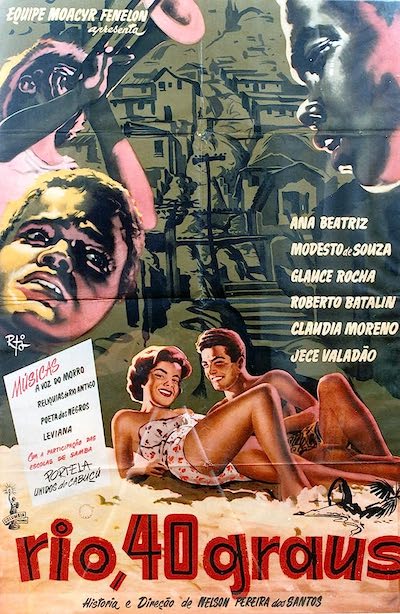
Nelson Pereira dos Santos – Rio Quarenta Graus aka Rio 40ºC (1955)
Drama1951-1960BrazilClassicsNelson Pereira dos Santos

Banned by Brazil’s Federal Department of Public Safety, “Rio, 40 Grau”s is a landmark film that ushered in the wave of Neorealist cinema in Brazil – Cinema Novo. The film chronicles a day in the life of five peanut vendors from the favelas (shanty towns) of Rio de Janeiro. Other subplots involving characters they meet along the way are interspersed. This was one of the first Brazilian films to address the issues of race, poverty, and class. These themes would continue to be examined by dos Santos throughout his career.Read More »