

Standing apart along the northeast shore of the Great Salt Lake is a huge earthworks project, boulders and potholes, clinging brine and mirrored sky, which the film documents, as it moves back geologically to dinosaur history.Read More »
Standing apart along the northeast shore of the Great Salt Lake is a huge earthworks project, boulders and potholes, clinging brine and mirrored sky, which the film documents, as it moves back geologically to dinosaur history.Read More »

This film was made by Hans Richter for the first Basel habitat exhibition to show the innovative aspects of modern architecture.
The remastering of this film was made by the Fondazione Cineteca Italiana (therefore the titles are in Italian).
The film is originally silent but is here accompanied by a recent soundtrack.Read More »
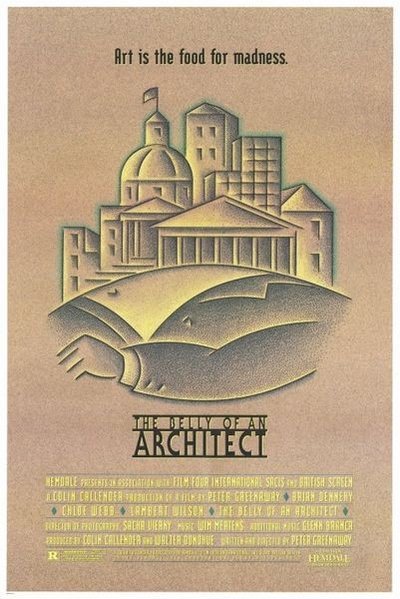
Quote:
STOURLEY KRACKLITE (Brian Dennehy), the central figure in Peter Greenaway’s ”Belly of an Architect,” is at one point seen reflected in the central panel of a triptych mirror in his Rome apartment, wearing a blood-red robe and flanked by multiple Xerox copies of classically sculpted abdomens, copies he has made from photographs of Roman statuary. It’s a perfect moment, or at least the kind of perfect moment Mr. Greenaway favors: orderly, symmetrical and obscure, offering great compositional beauty but no compelling reason why its riddles require solution.Read More »

Quote:
I began El Valley Centro in November of 1998; I was driving through the Great Central Valley looking for places to film. I wasn’t going to start shooting for at least six months; I wanted to just look and listen – to get to know the Valley well before I would make images. But almost immediately I came across an oil well fire with flames high into the sky. I returned home for my Bolex and Nagra. Determined that landscape is a function of time, I let a full roll of 16mm film (100 feet) run through the camera. At that moment I knew I would make a portrait of The Great Central Valley using 35 two and a half minute shots.Read More »

Quote:
New York City’s Monterey is a residence hotel; the residents we see are older, most live alone. The camera, usually stationery, begins with a look into the lobby. The film ends with a panorama from the hotel’s rooftop. There’s no soundtrack. The lobby is clean with granite floors. Men wear hats. People enter and exit an elevator. The camera looks out from within the elevator as doors open and close. People sit alone and motionless in their apartments. There are long shots of empty halls. Paint peels. The flooring on upper levels is linoleum. Hall lights are florescent. Doors open a crack then close. The film provides the feeling of what it’s like to live there.Read More »

Inspired by a lesson from Erik Satie; a film in the form of a street – Castro Street running by the Standard Oil Refinery in Richmond, California … switch engines on one side and refinery tanks, stacks and buildings on the other – the street and film, ending at a red lumber company. All visual and sound elements from the street, progressing from the beginning to the end of the street, one side is black-and-white (secondary), and one side is colour – like male and female elements. The emergence of a long switch-engine shot (black-and-white solo) is to the filmmaker the essential of consciousness.Read More »

A Korean-born man finds himself stuck in Columbus, Indiana, where his architect father is in a coma. The man meets a young woman who wants to stay in Columbus with her mother, a recovering addict, instead of pursuing her own dreams.Read More »

Quote:
“Landsbykirken” or “The Village Church” takes us back to the Danish old churches built in the Middle Age and their transformations through the years and through the dominant groups of a certain period, like the Christians and the Protestants, and the new things they were modifying in those constructions.Read More »
