Dedicated to the 80th anniversary of the director. The film uses unique materials related to the years Tarkovsky spent in Italy: Florence, where he lived, and where his museum now exists, at a place called Banja Vignoni, where “Nostalgia” was filmed in the house of the Italian screenwriter Tonino Guerra.
The film will include rare unique images: young Tarkovsky on the set, fragments of the documentary “Time of travel”, which was filmed in Italy by Andrei Tarkovsky with Tonino Guerra. For the first time viewers will see the location of filming of “Stalker” in Estonia…Read More »
“This film was conceived in honor of the 20th anniversary of the death of one of the greatest directors in the history of cinema – Andrei Tarkovsky. The young filmmaker Dmitry Trakovsky sets out in search of his favorite director’s legacy. His journey leads him to fifteen moving interviews in California, Italy, Sweden, and finally, Russia, as he attempts to come closer to the meaning of one of Tarkovsky’s most enigmatic beliefs… that death doesn’t exist. The result is the acclaimed documentary MEETING ANDREI TARKOVSKY, which takes an in-depth and poetic look at the late Russian filmmaker who created under the oppressive censorship of the Soviet government. It explores the life and films of Tarkovsky through diverse interviews and stories told by friends, colleagues and others who have been influenced by his art, providing a rare glimpse into Tarkovsky’s working methods and personal philosophy of humanity.”Read More »
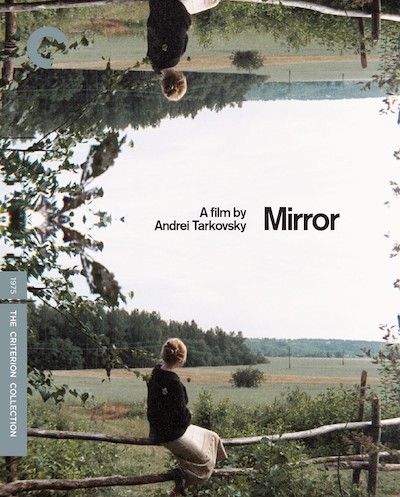
SYNOPSIS With Zerkalo (The Mirror), legendary Russian filmmaker Andrei Tarkovsky crafts perhaps his most profound and compelling film. What started off for Tarkovsky as a planned series of interviews with his own mother evolved into a lyrical and complex circular meditation on love, loyalty, memory, and history. Time shifts and generations merge as a single extraordinary actress (Margarita Terekhova) plays the narrator’s former wife as well as his mother. Tarkovsky’s memories as well as those of his mother are intermingled as a dark, sumptuous, and dreamlike pre-World War II Russia is evoked, accompanied throughout by the voice of Tarkovsky’s father reading his own elegiac poetry. The spectacle of nature and its ubiquitous and ever-shifting presence is captured by Tarkovsky’s camera as if by magic–the family cabin nestled deep in the verdant woods, a barn on fire in the middle of a gentle rainstorm, a gigantic wind enveloping a man as he walks through a wheat field–all creating indelible images with deep if mysterious emotional resonance. As the timeline shifts between the narrator’s generation and his mother’s, newsreel footage of Russian wars, triumphs, and disasters are juxtaposed with imagined scenes from the past, present, and future, crafting a silently lucid cinematic panopticon of memory, history, and nature. (Rotten Tomatoes)Read More »
Quote:
During earthworks, the utility crew discovers a German ammunition depot left over from the war. 30 tons of explosives lay in the ground for 15 years. According to the instructions, it is impossible to demine – it is dangerous to touch them. But it is also impossible to blow up – there are residential areas around. The case is entrusted to the group of Captain Galich. By 10 a.m. the next day, the entire population is evacuated to the outskirts of the city, and in the ominous pit, seven people begin a game with death.Read More »
Eduard Artemiev – Tarkovsky movies OST (Solaris-The Mirror- Stalker)
Eduard Artemiev
In the latter part of the 1950’s, the engineer and mathematician Yevgeniy Murzin had a problem. He had just realized his life long dream of constructing music synthesizer (then called “ANS”) but knew no musician with sufficient imagination to explore its vast potential. In 1960, upon meeting 22-year-old Edward Artemyev, a recent graduate of the Moscow conservatoire, Murzin immediately felt he had found what he was searching for in the young composer, who embraced the new instrument and quickly mastered its many subtleties. Artemyev has since composed numerous works varying from electronic avant-garde to film music. He is probably best known for his collaboration with A. Tarkovskiy composing music for his films: “SOLARIS” in 1972, “THE MIRROR” in 1975 and “STALKER” in 1979; and with such filmmakers as Andrei Mikhalkov-Kontchalovskiy and Nikita Mikhalkov.Read More »
Quote: Shot on the film’s set, gives a fascinating insight into the making of Nostalghia and includes interviews with Tarkovsky, the cast and crew.Read More »
This extraordinary book is not just about filmmaking, it’s about all art…about life, faith, inner exploration and the Russian soul. It contains exquisite poetry, mostly written by his father, Arseniy Tarkovsky, and detailed descriptions of the making of several of his films as well as photos of them that are eerie, mystical, and incredibly beautiful. Tarkovsky is the master of making us see the wonder of creation in the most mundane subjects. He brings us one step closer in our journey towards the light. From page 43: “The allotted function of art is not, as is often assumed, to put across ideas, to propagate thoughts, to serve as an example. The aim of art is to prepare a person for death, to plough and harrow his soul, rendering it capable of turning to good”.Read More »
A revered filmmaker, Andrei Tarkovsky is secure in the long and illustrious line of Russian masters in arts and letters. Linking cinematic technique to broader questions of meaning and intrepretation, Robert Bird offers a wholly original investigation into the aesthetic principles of Tarvkovsky’s filmmaking. While providing a comprehensive analysis of his work in all media, including radio, theatre and opera, Bird argues that Tarkovsky was most at home in the cinema. Accordingly, the author dwells chiefly on Tarkovsky’s major films: Ivan’s Childhood, Andrei Rublev, Solaris, Mirror, Stalker, Nostalghia and Sacrifice. With its wealth of film stills and photographs, this book is a key text for all admirers of Tarkovsky and European cinema.Read More »