Description: The subject of this film is a true case that happened in the city of Bremen: The story of citizen Geesche Gottfried (Margit Carstensen), widowed Miltenberger, who killed 15 people, among them her mother, her father, her children, two husbands and other persons from her immediate environs, while her fellow-citizens had considered her a respectable, god-fearing woman. In the end, she was unmasked and beheaded in 1831 – the last public execution in Bremen. Bremen Freedom is not a thriller. It is not the intention of the piece to gradually unmask the culprit. Like in a ballad, the killings are arranged in a kaleidoscope. The murderer’s motive is of interest in this play, but not how she is convicted. Geesche Gottfried murders because she wants to be free and because she does not want to be one of the men’s “pets”. “This was not a life, Michael, what mother lived there. In that case, death is a blessing for someone,” says Geesche Gottfried after murdering her own mother.Read More »
1971-1980
-
Rainer Werner Fassbinder – Bremer Freiheit AKA Bremen Freedom (1972)
1971-1980ArthouseDramaGermanyRainer Werner Fassbinder -
Marguerite Duras – Le navire Night (1979)
1971-1980ArthouseDramaFranceMarguerite DurasQuote:
The plot of Le Navire Night concerns a love affair between a young man and a woman, F., who first make contact by telephone one night, quite by chance. They have never seen each other or met before, but a relationship begins as a result of the conversation; F. continues telephoning. He, however, never learns F.’ s full name, telephone number or address, and all initiative for the relationship falls to her. The affair unfolds purely as an affair of the human voice, but this adds to the sexual intensity of the relationship rather than detracting from it: ‘C’est un orgasme noir,’ one hears the voice of Bulle Ogier saying. ‘Sans toucher réciproque. Ni visage. Les yeux fermés. Ta voix, seule’ (‘It’s a dark orgasm. Without mutual touching. Nor a face. Eyes closed. Just your voice’, N, 27–8). Three years go by, and the pair agree to meet. (In the 1978 magazine version the meeting is F.’ s idea, while, in the later version, it is the man who insists on seeing F., but only as a way of putting an end to his fear of seeing her [N, 33]; in this respect it is as though the desire to see belongs to neither her nor him, but circulates between them as a necessary step that must continually be envisaged yet constantly deferred.)Read More »
-
Rainer Werner Fassbinder – Satansbraten AKA Satan’s Brew (1976)
1971-1980ArthouseComedyGermanyRainer Werner Fassbinder
Walter, a German anarchist poet, is short of money after his publisher refuses to give him an advance. He tries various ways of raising money, including shooting one of his mistresses and relying on the life savings of a woman from the country who is fanatically devoted to him. He also has to contend with his long-suffering wife, his fly-obsessed crazy brother, his other mistress and a police murder investigation.
A Review:
This is my favorite Fassbinder movie and this for several reasons. The most important of these is, that the movie has a rhythmical quality from the beginning to the end. Also there are literally hundreds of remarkable quotes inside. It is black humorous, funny and the overacting is terrific. It is amazing how Fassbinder manages to change the mood radically from scene to scene, how he is playing with emotion, speed and dynamic.Read More »
-
Robert Bresson – Notes On Cinematography (1977)
1971-1980BooksFranceRobert BressonThis is not a book about cinematography. Cinematography is what Bresson regards as valid film making, as opposed to cinema which is just photographing a play, or the theatre, which is just lies told on a stage (or something). This book contains all the little notes, ideas and bon mots that Bresson jotted down over the years. Some are insightful, most are quite arrogant and dismissive, and quite a few are a bit bonkers. Anyway it’s an interesting look into the mind of a master and fairly short (although that didn’t stop it from being a pain in the arse to scan).
Originally written in French (Notes sur le cinématographe), this is the English translation by Jonathon Griffin.Read More »
-
Danièle Huillet & Jean-Marie Straub – Moses und Aron (1975)
1971-1980ArthouseAustriaDanièle Huillet and Jean-Marie StraubPerformanceThis is one of the best opera films ever, one of the few to intelligently juxtapose image and music. S and H’s minimal visual style allows Schoenberg’s maximal musical style to flourish, and there are even spots where we have a black screen, with music only. Filmed outdoors, in natural locations.
Schoenberg’s opera is one of the landmarks of 20th century music, and is heard and seen at its best in this performance.
‘With Moses und Aron, I have tried to destroy Stravinsky’s quote
saying that music was powerless to express the most abstract, the
most ordinary, the most concrete things.’ (Jean-Marie Straub)Read More » -
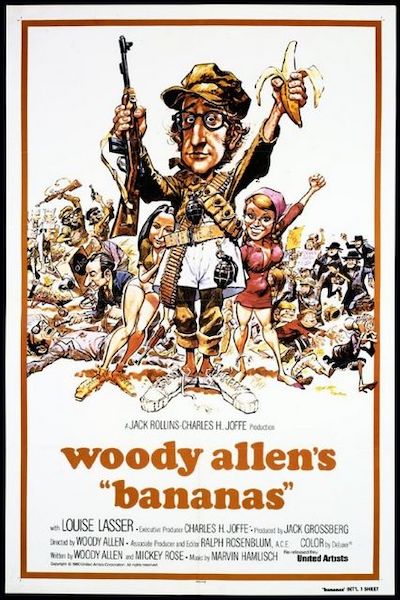
Woody Allen – Bananas (1971)
1971-1980ComedyUSAWoody AllenSynopsis:
One of Woody Allen’s earlier, more slapstick-oriented efforts, Bananas tells the story of Fielding Mellish (Allen), a neurotic New Yorker who follows the object of his affections, Nancy (Louise Lasser), to the fictional Central American country of San Marcos, where she is involved in a revolution. Nancy wants nothing to do with Fielding, but he soon becomes a guest of the country’s dictator (Carlos Montalban), before accidentally becoming the leader of San Marcos himself. Fielding is eventually shipped back to the US and tried as a subversive, but being that this is a comedy, and an especially light one at that, everything works out in the end. A far cry from Allen’s later, more somber films, Bananas still works as an often hilarious amalgam of sight gags, one-liners, and bizarre asides.
— Don KayeRead More » -
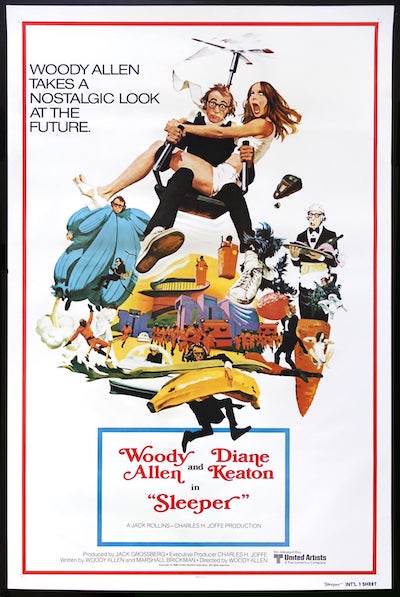
Woody Allen – Sleeper (1973)
1971-1980ComedySci-FiUSAWoody Allen

Quote:
In 1973, health-food store owner Miles Monroe (Woody Allen) enters the hospital for a routine gall bladder operation. When he expires on the operating table, Miles’ sister requests permission to cryogenically freeze her brother’s body. After 200 years, Miles is unwrapped by a group of scientists and awakens to a “brave new world” of deadening conformity, ruled with an iron fist by a never-seen leader. Miles is forced to flee for his life when the scientists — actually a group of revolutionary activists — are overpowered by the leader’s police. He eludes the cops by pretending to be an android, and in this guise is sent to work at the home of Luna (Diane Keaton), a composer of greeting cards who thinks that the world of the future is perfect as it stands. There’s more, but why spoil your fun? Sleeper is the most visual of Woody Allen’s earlier films, and demonstrated a more pronounced rapport between Allen and his off- and onscreen leading lady Diane Keaton than had previously existed. The Dixieland score is performed by the Preservation Hall Jazz Band. ~ Hal Erickson, All Movie GuideRead More » -
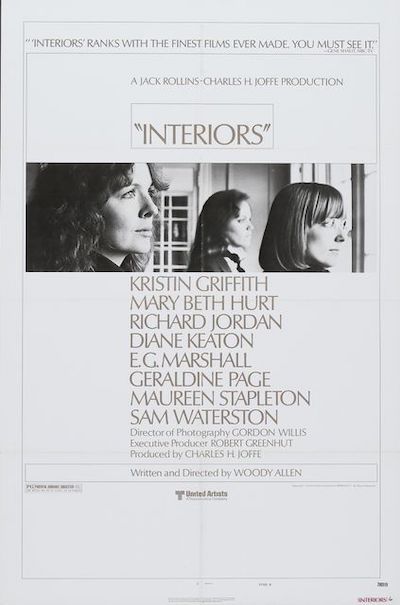
Woody Allen – Interiors (1978)
1971-1980DramaUSAWoody AllenThree sisters find their lives spinning out of control in the wake of their parents’ sudden, unexpected divorce.Read More »
-
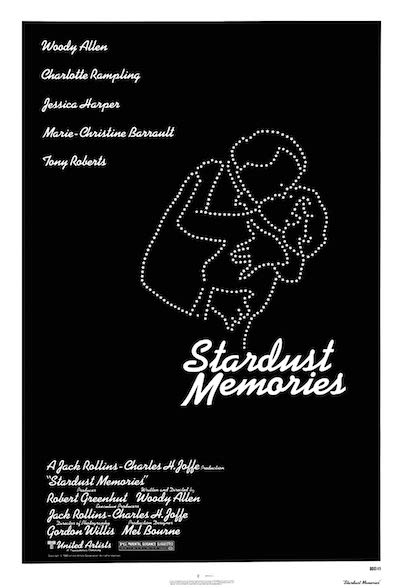
Woody Allen – Stardust Memories (1980)
1971-1980ArthouseComedyUSAWoody AllenQuote:
Because Annie Hall and Manhattan, the two highly revered comedies that preceded 1980’s Stardust Memories, concerned themselves with characters whose insecurities led to the demise of their relationships, Woody Allen’s somewhat polarizing 30-year-old homage to 8 1/2 surprised me in its reversal of the old break-up stand-by, “it’s not you, it’s me.” Sandy Bates (Allen), the successful comedic filmmaker in Stardust Memories, could safely say to his chronically depressed lover Dorrie (Charlotte Rampling), “It’s not me, it’s you.” While he bears the bulk of the blame for the setbacks in his current relationships (thanks to a mental breakdown of sorts), Sandy’s most cherished romance wasn’t sabotaged by the self-hatred and neurosis we’ve come to expect from Allen’s stories, but rather by a cloud of melancholy constantly hovering over Dorrie.Read More »