1971-1980

  • Wilhelm and Birgit Hein – Materialfilme (1976)

    1971-1980ExperimentalGermanyWilhelm and Birgit Hein

    Free Image Hosting at www.ImageShack.us

    29f7c043f76a2bde437fd0d52a185152

    Quote:
    For their 35mm Materialfilme (1976), the Heins randomly spliced together a mix of color and black and white material taken from the header and footer of commercial films. The scratches, scribbles, hand-written and commercially printed numbers and dots that adorn such footage rush past the eye until they are replaced by images consisting only of washed-out colors or scratched black and white frames. The Heins acquired this material during their years as programmers and projectionists for various avant-garde and commercial film screenings. […] Over the years, this watercolor paint had faded and cracked, and various blotches, scratches and other irregularities have scarred the surface of the filmstrip. In projection, these marks of the material enter into arbitrary rhythmic relationships with the movement of color and the interrupting flashes of white light.Read More »

  • Carmelo Bene – Salome (1972)

    1971-1980ArthouseCarmelo BeneExperimentalItaly

    29f7c043f76a2bde437fd0d52a185152

    This experimental film by the maverick Italian director Carmelo Bene is a free adaptation of Oscar Wilde’s play Salome and is even more irreverent than the original. In this film, Bene carries the New Testament story beyond the incident with Herod, and pictures Christ nailing himself to the cross, unable (of course) to finish the task. This film uses many musical and filmic special effects and includes at least one pornographic sequence and a number of sadistic ones. ~ Clarke Fountain, All Movie GuideRead More »

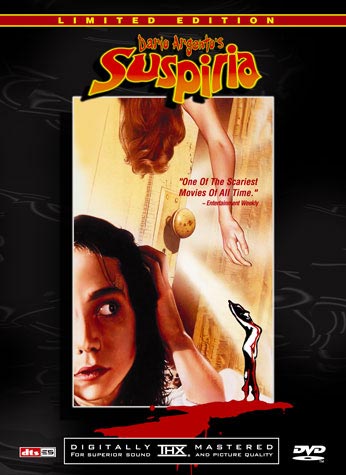
  • Dario Argento – Suspiria + 25th Anniversary Documentary (1977)

    1971-1980CultDario ArgentoHorrorItaly

    29f7c043f76a2bde437fd0d52a185152

    PLOT SUMMARY:
    A young American dancer travels to Europe to join a famous ballet school. As she arrives, the camera turns to another young woman, who appears to be fleeing from the school. She returns to her apartment where she is gruesomely murdered by a hideous creature. Meanwhile, the young American is trying to settle in at the ballet school, but hears strange noises and is troubled by bizarre occurrences. She eventually discovers that the school is merely a front for a much more sinister organization.
    source = IMDB
    Read More »

  • Nagisa Oshima – Ai no borei AKA Empire of Passion [+Extras] (1978)

    1971-1980ArthouseHorrorJapanNagisa Oshima

    29f7c043f76a2bde437fd0d52a185152

    Quote:
    With an arresting mix of eroticism and horror, Oshima plunges the viewer into a nightmarish tale of guilt and retribution in Empire of Passion (Ai no borei). Set in a Japanese village at the end of the nineteenth century, the film details the emotional and physical downfall of a married woman and her younger lover following their decision to murder her husband and dump his body in a well. Empire of Passion was Oshima’s only true kaidan (Japanese ghost story), and the film, a savage, unrelenting experience, earned him the best director award at the Cannes Film Festival.Read More »

  • Nicolas Roeg – Bad Timing (1980)

    1971-1980ArthouseDramaNicolas RoegUnited Kingdom

    29f7c043f76a2bde437fd0d52a185152

    The setting is Vienna. A young American woman is brought to a hospital after overdosing on pills, apparently in a suicide attempt. A police detective suspects foul play on the part of her lover, an American psychology professor. As doctors try to save her life, the detective interrogates the professor, and through flashbacks we see the events leading up to the woman’s overdose; her stormy and intensely sexual relationship with the professor, her heavy drinking and numerous affairs, and her estrangement from her Czech husband. A darkly erotic study of several rather unsympathetic characters. Written by Marty CassadyRead More »

  • Pink Floyd – Dark Side of the Moon Tour Comic Book (1975)

    1971-1980ComicsPink FloydUnited Kingdom

    “Super All-Action Official Music Programme For Boys And Girls!”
    High quality scans – jpeg, 1704 x 2204 px, 199 px/inch.
    Nice trinket for Pink Floyd fans.Read More »

  • Paul Morrissey – Dracula cerca sangue di vergine… e morì di sete!!! AKA Blood for Dracula [+Extras] (1974)

    1971-1980CultHorrorItalyPaul Morrissey

    29f7c043f76a2bde437fd0d52a185152

    Plot Synopsis by Cavett Binion

    The second of two horror films shot in a single production term and bearing the name of pop-art icon Andy Warhol (whose participation pretty much ended with the use of his name), this film is slightly superior to its higher-profile predecessor, Andy Warhol’s Frankenstein. Direction is credited to Warhol factory filmmaker Paul Morrissey, though there still exists a very vocal camp who insist that the real credit should go to Italian director Antonio Margheriti. Euro-horror leading man Udo Kier assays the title role, playing the count as a pale, anemic-looking blood junkie with an overwrought accent. Finding the supply of “weer-gin” blood diminishing rapidly in Romania, Dracula is forced to seek a fix in a predominantly Catholic Italian province, where he is certain a few virgins still exist. He travels with his assistant (Arno Juerging) and his coffin-sealed sister to the decrepit, crumbling mansion of the financially-strapped Marquis DiFore (a tour-de-force performance from Bicycle Thief director Vittorio de Sica) who welcomes the affluent Count with open arms, hoping to marry off any one of his four daughters. Dracula clearly has other intentions for the girls… but his plans are rudely thwarted by beefy, socialist handyman Mario (Joe Dallesandro), who has been dutifully divesting the young maidens of their — ahem — virtue, thus tainting their blood and making it unsafe for vampiric consumption. Very unsafe, it turns out — as we are treated to protracted scenes of the death-pale Count vomiting up gallons of blood. Rated “X” at the time of its release (and subsequently re-rated “R” ten years later), this outrageous catalogue of depravity features wildly campy performances, inane dialogue and an outrageous climax.Read More »

  • Nando Cicero – Il gatto mammone (1975)

    1971-1980ComedyItalyNando Cicero

    29f7c043f76a2bde437fd0d52a185152

    Imdb:
    Typical Italian comedy from the 70’s, 17 February 2005
    7/10
    Author: garypayton20 from Italy

    A classic Italian comedy from the 70s, when the sexuality was getting more explicit and usually mixed with funny misunderstandings. It’s the story of a man (Lando Buzzanca) whose wife cannot get pregnant, so they decide to “adopt” a mother girl and to ask her to help them…you can imagine how. It’s a funny comedy overall, not better and not worst from the Italian comedies of the time, whose cultural and social contents typical from the 50s-60s were replaced by explicit (and sometimes unappropriated ) sexuality. What i can tell you is, it’s 4.44 am here in Italy, i am watching this movie in the TV. If you ever find yourself in my situation, without sleep and without nothing to read, watch this movie….it’s OK for a night like this.Read More »

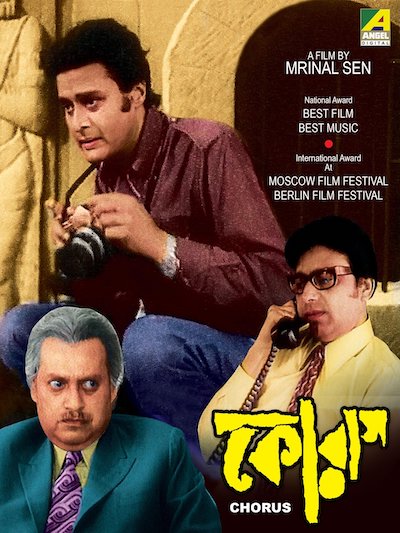
  • Mrinal Sen – Chorus (1975)

    1971-1980FantasyIndiaMrinal SenPolitics

    Synopsis:

    Starting out as a fantasy mythological with the gods, entrenched in their fortress, deciding to create 100 jobs, the film becomes an exemplary fairy tale when 30,000 applicants start queuing up for work. The fairy tale then becomes a didactic tragedy with realist sequences (media men interviewing individuals in the crowd of applicants) when the people realise the job scheme is grossly inadequate and popular discontent grows into a desire to storm the citadel. Freely mixing different styles and modes of storytelling including direct address to the camera, with the chorus both as narrator and as political agitator (R. Ghosh, who also plays god and the sutradhara), Sen continues exploring the possibilities of a cinematic narrative that would be both enlightening and emotionally involving without descending into authoritarian sloganising. Having gone as far in this direction as he could, Sen deploys the lessons of his experiments with complex and stylistically diverse cinematic idioms in his next feature, Mrigaya (1976).Read More »

Back to top button