1971-1980

  • Arthur Mac Caig – The Patriot Game (1979)

    1971-1980Arthur Mac CaigDocumentaryIrelandPolitics

    Icarus Films wrote:
    Rich in emotional images, often tender but more often terrifying, The Patriot Game tells the story of the long and bitter battle for Northern Ireland.

    The film’s introduction covers Ireland’s history from British colonization to the territory’s division in 1922. The Patriot Game then details the events of the decade that began in 1968. Through powerful portraits of rebellion and eyewitness accounts of killings and such massacres as the infamous “Bloody Sunday,” the film shows the IRA at work – much of it filmed clandestinely – as they argue their cause which, in this country and in most of the world, has gone unheard.Read More »

  • Peter Collinson – Tomorrow Never Comes (1978)

    1971-1980CanadaCrimePeter CollinsonThriller

    Summary:
    Coming back from an extended business trip, Frank discovers that his girlfriend Janie is now working at a new resort hotel where the owner has given her a permanent place to stay, as well as other gifts, in exchange for her affections. In the course of fighting over this development, tensions between Frank and Janie escalate out of control until he is holding her hostage in a standoff with the police. As the negotiators try to talk Frank into giving himself up, the desperate man feels himself being pushed further and further into a corner.Read More »

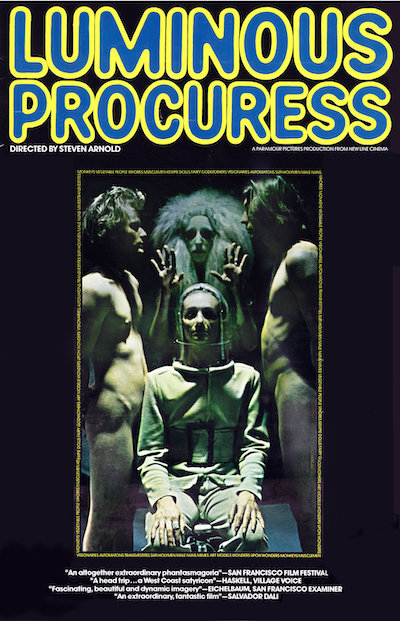
  • Steven Arnold – Luminous Procuress (1972)

    1971-1980CultExperimentalSteven ArnoldUSA

    Dalí considered Luminous Procuress ‘a work of genius’. Featuring members of legendary San Francisco performance troupe The Cockettes, the film was directed by the artist and filmmaker Steven Arnold, a muse and model of Dalí’s. Dalí always referred to Arnold as his ‘prince’, and allegedly co-produced (or at least partly funded) the film, for which he held an elaborate screening at the St. Regis Hotel in New York. Andy Warhol and numerous luminaries of New York society attended the spectacular event, and Dalí projected the film upside down, backwards and sideways. The Village Voice called the film ‘a tour de force of the imagination – a journey through peekboxes of naked tableaux, theatres of mechanical dreams, feasts of monsters and piles of humanity.’Read More »

  • Jules Dassin – Kravgi gynaikon aka A Dream of Passion (1978)

    1971-1980ArthouseDramaGreeceJules Dassin

    Quote:
    The husband and wife team of director Jules Dassin and actress Melina Mercouri, who first enjoyed international success with the comedy Never on Sunday, collaborated for the last time on this powerful drama. Maya (Melina Mercouri) is a famous actress who is returning to the stage for a production of the classic Greek tragedy Medea, in which she will play the title character, a mother who murders her children. Kostas (Andreas Voutsinas), Maya’s former lover, will be directing Maya in the production, and when he discovers that Brenda (Ellen Burstyn), an American woman, is housed in a nearby Greek prison for killing her offspring, he suggests that Maya should meet Brenda as a means of better understanding her character. Read More »

  • Jean Rollin – La nuit des traquées aka The Night of the Hunted (1980)

    1971-1980EroticaFranceHorrorJean Rollin

    Synopsis:
    A woman is taken to a mysterious clinic whose patients have a mental disorder in which their memories and identities are disintegrating as a result of a strange environmental accident.Read More »

  • Mani Kaul – Satah Se Uthata Aadmi aka Arising From The Surface (1980)

    Arthouse1971-1980ExperimentalIndiaMani Kaul

    Quote:
    Kaul’s film addresses the writings of Gajanan Madhav Muktibodh (1917-79), one of the main representatives of the Nai Kavita (New Poetry) movement in Hindi. Muktibodh also wrote several short stories, one of which provides the film with its title, and critical essays. The film integrates episodes from Muktibodh’s writings with material from other source, including a reinvented neo-realism derived from Muktibodh’s literary settings. The narrative is constructed around 3 characters. Ramesh (Gopi) iis one who speaks and enacts Muktibodh’s writings, functioning as the first-person voice of the text; his two friends, , Madhav (Jha) and Keshav (Raina), are Ramesh’s antagonists and interlocuters esp. in the debates about modernity. Kaul gradually minimizes the fictional settings until, in the remarkably shot sequences of the factory, the audience is directly confronted with the written text itself.Read More »

  • Werner Herzog – La Soufrière AKA La Soufrière – Warten auf eine unausweichliche Katastrophe (1977)

    1971-1980DocumentaryGermanyShort FilmWerner Herzog

    Quote:
    Herzog takes a film crew to the island of Guadeloupe when he hears that the volcano on the island is going to erupt. Everyone has left, except for one old man who refuses to leave. Herzog catches the eeriness of an abandoned city, with stop lights cycling over an empty intersection.Read More »

  • Maurice Pialat – Loulou (1980)

    1971-1980ArthouseDramaFranceMaurice Pialat

    Synopsis:
    Maurice Pialat’s portrait of contemporary France mocks prosperity as a substitute for social and sexual revolution. Nelly abandons her bourgeois friends and a steady relationship for the unemployed layabout Loulou, whose charms include focusing his energy into sex.Read More »

  • Jean-Claude Brisseau – La vie comme ça AKA Life the Way It Is (1978)

    1971-1980ArthouseDramaFranceJean-Claude Brisseau

    Quote:
    The second film by Jean-Claude Brisseau is this gritty story of working women in the modern world. Originally shot on 16mm for French television, Life the Way It Is (La Vie Comme Ca) may be the director’s most radical film, with its images of suicide, group violence, and sexual pressure. Agnes Tessier leaves the comfortable confines of school to work at a chemical factory in a slum district with her friend Florence. When greeted with sexual harassment, harsh conditions, and volatile coworkers, Agnes responds by applying for the union rep position in order to challenge the status quo at the factory. Stripped down to the essentials, the film reflects the fury of working-class women everywhere.Read More »

Back to top button