The post Kira Muratova – Korotkiye vstrechi AKA Brief Encounters (1967) first appeared on Cinema of the World.
]]>

Anna Lawton wrote:
After a brilliant debut with Our Daily Bread (1965), co-directed with her husband Alexander Muratov, Muratova was allowed to make her own film, Brief Encounters (1967). On the surface the story was simple enough. Valentina, a conscientious civil servant in charge of the regional housing office, and Maxim, a geologist-prospector and guitar player devoted to an itinerant and adventurous life, have a difficult relationship – a series of brief encounters and lengthy separations. Their episodic meetings bring into focus their love and need for each other, but also their basic differences, disappointments, and resentment. There is a third character in this love triangle, Nadya, a country girl Valentina hires as a maid without knowing of her past relation with Maxim.


Korotkie vstrechi - Kira Muratova (1967).mkv

General
Container:  	Matroska
Runtime: 	1 h 35 min
Size: 	2.40 GiB
Video
Codec: 	x264
Resolution: 	790x576
Aspect ratio:  	1.372
Frame rate: 	24.000 fps
Bit rate: 	3 382 kb/s
BPP: 	0.310
Audio
#1:  	1.0ch FLAC @ 188 kb/s (Russian)
https://nitro.download/view/D1D8928F2319528/Korotkie_vstrechi_-_Kira_Muratova_(1967).mkv
Language(s):Russian
Subtitles:English, German
The post Kira Muratova – Korotkiye vstrechi AKA Brief Encounters (1967) first appeared on Cinema of the World.
]]>The post Aleksey German – Moy drug Ivan Lapshin AKA My Friend Ivan Lapshin (1985) first appeared on Cinema of the World.
]]>
Quote:
Aleksei German’s singular, multithreaded drama My Friend Ivan Lapshin offers a uniquely stylized look at life in Russia as the flaws of Communism were just beginning to show. Set in a provincial Russian village during the 1930s, the film at times recalls the autobiographical work of Terence Davies or Woody Allen’s Radio Days. Like the work of those directors, German’s film filters most experiences through the eyes of a child, although the child/narrator in this particular movie is not present in the majority of the scenes. Instead, German turns his roving camera into a surrogate for the child, usually having it track behind characters or wander curiously throughout the scenes. This gives the film a unique feel, as narrative incident is scarcely privileged over background detail. As with many of our memories, most things here only begin make sense in retrospect, as they are mulled over in the mind. So, while Ivan Lapshin offers a story about a small town police officer who seems precariously perched on the abuse of his power, an investigation of memory itself begins to feel like the film’s prime attraction.
In the opening scene of Ivan Lapshin, a narrator explains that his story is a “declaration of love for the people I lived with as a child, just five minutes’ walk from here and a half a century ago.” As fifty years and five blocks would imply, memory is viewed here as something slippery; almost tangible yet just out of reach. Outright realism often gives way to clearly staged pictorial beauty, reminding us that we are viewing a subjective memory. German switches, almost at random, between scenes shot in color and black and white. A voiceover occasionally intrudes upon the action, to further emphasize the constructedness of all memory. The resulting film, which revels in the past even as it seems soberly aware of the disappointment to come, would likely be probably intensely nostalgic for anyone who lived under Communism.
For the rest of us, My Friend Ivan Lapshin offers a distinctive, yet mildly uninvolving mélange. The indirectness of the film’s point of view makes it somewhat difficult to interpret precisely what it is trying to communicate about Communist Russia. Throughout the movie we are shown the optimism of the people, yet at the same time, whether through the agony caused by a spilt canister of petrol or the way that the characters’ cramped living spaces squelch privacy, we are made aware of the costs of collectivism. Characters talk hopefully about the future but we, like the narrator, know of the disappointment to come. Perhaps the most potent message, though, is found in the brief sequences that return us to the 1980s, from which the story is being told. Little in the physical environment in the fictional town in which the film takes place seems to have been changed in the fifty years since Ivan’s story unfolded, but it’s made quite clear that a way of life has died.


1.46GB | 1h 34mn | 767×556 | mkv
https://nitroflare.com/view/DDA4F1FF085697D/Aleksey_German_-_(1984)_My_Friend_Ivan_Lapshin.mkv
Language:Russian
Subtitles:English, French
The post Aleksey German – Moy drug Ivan Lapshin AKA My Friend Ivan Lapshin (1985) first appeared on Cinema of the World.
]]>The post Yuri Kara – Zavtra byla voyna AKA Tomorrow Was the War [+Extras] (1987) first appeared on Cinema of the World.
]]>
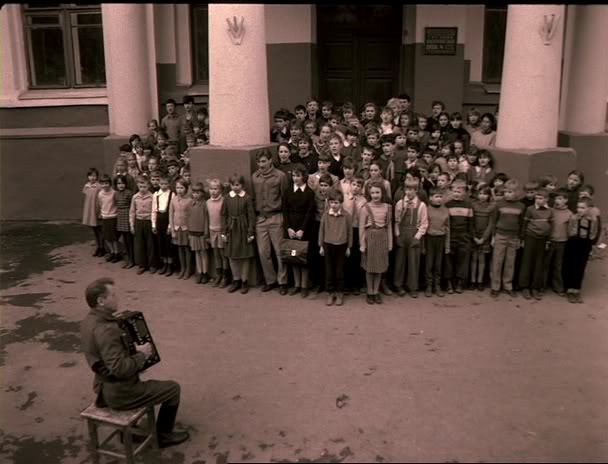
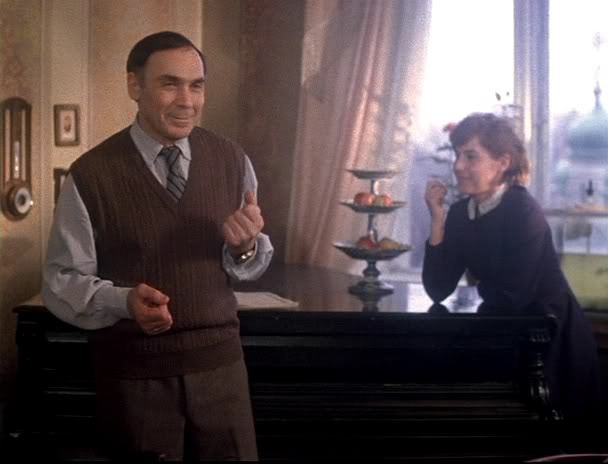
This film is based on a novel by Boris Vasiliev and takes place in a small Russian provincial town in 1940, one year before Germany invaded the Soviet Union. The every day life of class 9B is a larger than life portrait of Stalininism and of unconditional loyalty to party dogma.
At a birthday party a girl, one of the students, recites poetry by a “bourgeois” author. The information leaks out and her liberal father is arrested as a dissident. The daughter is faced by the class teacher and asked to publicly renounce her father which leads to a tragedy. This causes both inner and outer conflicts, the colleagues start to rebel and to question their loyalty, be it to the class teacher or the soviet ideology itself.
With political restrictions in the Soviet Union being gradually lifted in the 1980s, this was one of the first films to mention the previously taboo subject of the night time raids by the KGB, in which innocent people were dragged from their homes and jailed.
SPECIAL FEATURES
• Introduction by director Yuri Kara
• Interview with actor Sergei Nikonenko


1.08GB | 1:24:30 | 608×464 | avi
https://nitro.download/view/7BEE531F63E9002/Tomorrow_Was_the_War_(Yuri_Kara,_1987).avi
https://nitro.download/view/6AD15ADA45FA2A2/Tomorrow_Was_the_War_(Yuri_Kara,_1987).srt
https://nitro.download/view/BACD0C941BDE727/Interview_with_actor_Sergei_Nikonenko.avi
https://nitro.download/view/E1E47874F457B83/Interview_with_actor_Sergei_Nikonenko.srt
https://nitro.download/view/7D851A73802131D/Introduction_by_director_Yuri_Kara.avi
https://nitro.download/view/E389EF78773DC6A/Introduction_by_director_Yuri_Kara.srt
Language(s):Russian
Subtitles:English [SRT]
The post Yuri Kara – Zavtra byla voyna AKA Tomorrow Was the War [+Extras] (1987) first appeared on Cinema of the World.
]]>The post Aleksey German – Khrustalyov, mashinu! AKA Khrustalyov, My Car! [+commentary] (1998) first appeared on Cinema of the World.
]]>
IMDb wrote:
Military doctor General Klenski is arrested in Stalin’s Russia in 1953 during an anti-Semitic political campaign accused of being a participant in so-called “doctors’ plot”.
Quote:
Named after the apocryphal exclamation of Soviet security chief Lavrentiy Beria as he rushed to Stalin’s deathbed, this blackly funny, deliriously immersive satire distils the anticipation and anxiety in the Moscow air, as the Soviet despot lay dying.
Late winter 1953. The lives of nearly half the planet are in Stalin’s hands. A military surgeon, General Yuri Georgievich Klensky (Yuri Tsurilo), finds himself a target of the “”Doctors’ Plot””: the anti-Semitic conspiracy accusing Jewish doctors in Moscow of planning to assassinate the Soviet elite. Pursued, abused, and marked for the gulags, Yuri is chased and dragged through a Stalinist Soviet nightmare. His desperate, jolting journey encapsulates the madness of the era.


3.90GB | 2 h 26 min | 788×576 | mkv
Language:Russian
Subtitles:English
The post Aleksey German – Khrustalyov, mashinu! AKA Khrustalyov, My Car! [+commentary] (1998) first appeared on Cinema of the World.
]]>The post Kira Muratova – Korotkie vstrechi AKA Brief Encounters (1967) first appeared on Cinema of the World.
]]>
kinoglaz.fr:
Nadya (Nina Ruslanova) is a young woman who loves the geologist Maxim (Vladimir Vysotsky). She takes a job as a housemaid before discovering Maxim is romantically involved with town official Valentina Ivanovna (Kira Muratova). The heartbroken Nadya goes away before Maxim can return, leaving him and Valentina to pursue their romance.
—
imdb:
Nadja, a country girl moves to the city and becomes Valya’s maid. Valya, a member of the District Soviet, does not know that Nadja fell in love with Valya’s currently absent husband, a geologist, when he was at her village on a recent expedition. Written by Erik Gregersen {[email protected]}
Brief Meetings is about a love triangle between three very different people. Nadia, a country girl, falls in love with Maskim, a roaming guitar playing geologist, and in her search for him she ends up working for Valentina, his long-distance, bureaucrat wife. Nadia begins to work as a maid for Valentina, but as they spend time together they have flashbacks to their brief meetings with Maskim. These flashbacks occur throughout the film and both Valentina and Nadia have them. Finally news arrives of Maskim’s return to Valentina. On the day of his return Nadia cooks a meal for them both and leaves before they arrive, Valentina never knew of Nadia’s encounters with Maskim, and Maskim will never know of Nadia’s time with Valentina. Written by David Leach –

Korotkie vstrechi (1968) 
Korotkie vstrechi (1968) 
Korotkie vstrechi (1968) 
Korotkie vstrechi (1968)
1.14Gb | 1h 35mn | 762×572 | mkv
http://nitroflare.com/view/B76422CAAE72A25/Kira_Muratova_-_(1967)_Brief_Encounters.mkv
http://nitroflare.com/view/C769BF79973FA28/Kira_Muratova_-_%281967%29_Brief_Encounters.srt
Language(s):Russian
Subtitles:English
The post Kira Muratova – Korotkie vstrechi AKA Brief Encounters (1967) first appeared on Cinema of the World.
]]>The post Aleksey German – Khrustalyov, mashinu! AKA Khrustalyov, My Car! (1998) first appeared on Cinema of the World.
]]>
Quote:
Winter is never-ending in Aleksei Guerman’s impenetrable film ”Khroustaliov, My Car!,” a nearly two-and-a-half hour absurdist nightmare of life in the Soviet Union during the final days of Stalin’s rule. Snow falls in almost every scene of this starkly grim, black-and-white movie, which follows the triumph, fall from grace and hasty rehabilitation of a hulking Red Army general and brain surgeon named Yuri Glinshi (Yuri Tsourilo). Processions of black government vehicles are forever materializing like ominous phantoms through the curtains of snow that drift over a dilapidated town decorated with gleaming white statues of the beady-eyed, mustached Soviet dictator.
In this land of horrors everything that isn’t white (the snow, the statues, the characters’ breath, the clouds of steam and smoke rising from ashcans) is inky black. The soundtrack is studded with harsh, grating whistles and screams, the dialogue fragmentary and hysterically agitated. In the scenes of Yuri at home with his large family, everyone runs around in circles shouting at once like lunatics in a mental hospital. When they’re not yelling, they’re spitting, coughing, smoking and drinking cognac out of mugs, pretending it is tea.
Before he is arrested in an anti-Semitic purge and shipped off to the gulag, Yuri rules the roost like a miniature Stalin. He has a string of mistresses. And when he visits the local hospital, his staff follows him around him like terrified minions.
The ugliest moment in a film that portrays human beings as stinking, phlegmatic beasts comes while Yuri is being transported to the gulag. In the back of the truck, his trousers are ripped off, and he is assaulted anally with the handle of a shovel.
”Khroustaliov, My Car!” is a nightmare all right. But it is one virtually impossible to decipher. Its characters aren’t properly identified, its politics not elucidated, its geography vague. The best way to appreciate the film is to sit back and view it as a Boschean vision of hell. Not everyone will have the patience to stay until the end, when Yuri is brought to Stalin’s deathbed in a futile attempt to save the dictator’s life. The movie, which is being shown this evening as part of the New York Film Festival, is an endurance test.


http://www.nitroflare.com/view/828F13CA87FC7A1/khrustalyov-mashinu-.mkv
Language(s):Russian
Subtitles:English sub/idx muxed
The post Aleksey German – Khrustalyov, mashinu! AKA Khrustalyov, My Car! (1998) first appeared on Cinema of the World.
]]>