The post Raoul Walsh – The Loves of Carmen (1927) first appeared on Cinema of the World.
]]>

Bad quality but very rare. I don’t know the source for this video, but it looks like a distant ancestor was a vhs.
Here’s an imdb review by lugonian:
THE LOVES OF CARMEN (Fox, 1927), directed by Raoul Walsh, reunites Walsh with his WHAT PRICE GLORY (1926) leading players of Dolores Del Rio and Victor McLaglen in a story based on Prosper Merimee’s classic story, “Carmen,” that later served as an 1875 Georges Bizet opera. For those unfamiliar with the plot, this edition, one of many, comes across as more faithful to the aforementioned properties from which it is based.
Set in 1820s Seville, Carmen (Dolores Del Rio), is a gypsy girl working in a cigar factory who is loved by Lieutenant Don Jose (Don Alvarado), as well as half of male population of Spain. She meets her match with Escamillo (Victor McLaglen), a famous matador and the idol of many women. Carmen makes every attempt to attract his attention, but all she gets for her trouble is him picking her up and throwing her into a puddle of water. To make her day complete, Carmen gets into an argument with one of her female co-workers followed by a physical fight with another after being called “an angel from the gutter.” This, of course, lands her in jail for disturbing the peace. Carmen’s sentence is cut short as Don Jose arranges for Carmen’s escape. For this he is placed on guard duty as punishment by his superior officer, Morales (Jack Bastian). He later faces a court martial for deserting his post to be alone with Carmen in her place of residence. After Don finds Morales with Carmen, the two men duel it out with swords, with the commander being killed in the process. For this, Don seeks refuge in the mountains, hiding in the gypsy camp with Carmen. As Carmen begins to become bored with Don, she breaks away from him to watch Escamillo in the bullring. This time she captures his attention, eventually becoming his mistress while Don Jose, a disgrace to his regiment, learns of this and goes into a jealous rage.
Other members of the cast consist of not so well known actors including Nancy Nash (Michela); Rafael Valverda (Miguel); Mathilde Comont (Emilia); Carmen Costello (Tersa); and Fred Kohler Sr. (The Gypsy Chief).
Mexican actress Dolores Del Rio excels in her role as Carmen, as does fellow Hispanic Don Alvarado playing Don Jose. The tall and rugged Victor McLaglen might seem an unlikely choice as the bullfighter, yet, under Walsh’s direction, gets by with his role. The sets and costumes capture the mood and period where it’s set, but in spite of this being a satisfactory production, it’s close to being virtually unknown to film scholars. THE LOVES OF CARMEN was once a lost item from cinema history, with no prints known to exist until its long awaited discovery in an European archive and restoration from film department staff members of Museum of Modern Art in New York City made it a reality to be shown again. Aside from limited public showings at the museum, THE LOVES OF CARMEN served as the sixth movie presented in the eight-week series of “Lost and Found” broadcast from June to August of 1978 on New York’s own public broadcasting station, WNET, Channel 13, hosted by Richard Schickel. Upon the conclusion of its television premiere, equipped with piano score at a length of 83 minutes, Schickel talked briefly about other Carmens of the screen, including a 1909 French film, two 1915 releases, one featuring opera star Geraldine Farrar under the direction of Cecil B. Demille for Paramount, and another starring Theda Bara directed by Raoul Walsh, along with comedian Charlie Chaplin’s interpretation in the featurette spoof, BURLESQUE ON CARMEN (1916) with Edna Purviance. (The most famous remakes, however, happens to be THE LOVES OF CARMEN (Columbia, 1948) with the alluring Rita Hayworth and the miscast Glenn Ford; and the modern-day opera with an all black cast, CARMEN JONES (20th Century-Fox, 1954) featuring Dorothy Dandridge and Harry Bellafonte.) Schickel also commented on Don Alvarado being one of many actors during the silent era to be promoted as another Latin lover type like Rudolph Valentino (1895-1926), yet failed living up to that legendary performer.
Regardless of its rediscovery and restoration, THE LOVES OF CARMEN hasn’t been seen much since its 1978 television presentation, and it doesn’t seem likely that it will circulate again. With so many Carmens on stage and screen, what’s one more addition to video, DVD or cable television broadcasts with the one and only Dolores Del Rio silently playing a flirt with her love and passion for destroying those around her, especially the men in her life. (***)


General / Container Stream #1
Total Video Streams for this File.................1
Total Audio Streams for this File.................1
Video Codecs Used.................................XviD
Audio Codecs Used.................................MPEG-1 Audio layer 3
File Format.......................................AVI
Play Time.........................................1h 23mn
Total File Size...................................1.14 GiB
Total Stream BitRate..............................1 941 Kbps
Video Stream #1
Codec (Human Name)................................MPEG-4 Visual
Codec (FourCC)....................................XVID
Codec Profile.....................................Simple@L3
Frame Width.......................................640 pixels
Frame Height......................................480 pixels
Frame Rate........................................23.976 fps
Total Frames......................................120741
Display Aspect Ratio..............................4:3
Scan Type.........................................Progressive
Color Space.......................................YUV
Codec Settings (Packet BitStream).................No
QF (like Gordian Knot)............................0.244
Codec Settings (BVOP).............................No
Codec Settings (QPel).............................No
Codec Settings (GMC)..............................No warppoints
Codec Settings (Matrix)...........................Default (H.263)
Video Stream Length...............................1h 23mn 55s 911ms
Video Stream BitRate..............................1 800 Kbps
Bit Depth.........................................8 bits
Video Stream Size.................................1.06 GiB (93%)
Video Encoder.....................................XviD0046
Audio Stream #1
Codec.............................................MPEG Audio
Codec (FourCC)....................................55
Codec Profile.....................................Joint stereo
Audio Stream Length...............................1h 23mn 55s 981ms
Audio Stream BitRate..............................128 Kbps
Audio Stream BitRate Mode.........................CBR
Number of Audio Channels..........................2
Sampling Rate.....................................48.0 KHz
Audio Stream Size.................................76.8 MiB (7%)
https://nitro.download/view/CB7B1E793C0961F/Loves_of_Carmen.avi
Language(s):Just music
Subtitles:none
The post Raoul Walsh – The Loves of Carmen (1927) first appeared on Cinema of the World.
]]>The post Emilio Fernández – Bugambilia (1945) first appeared on Cinema of the World.
]]>
David Melville writes —
Fans of old Hollywood may remember Dolores del Rio as a ravishing beauty who couldn’t act. Moving from Mexico to the US in the late 20s, she played decorative roles in largely mediocre films. Even the classic South Seas romance Bird of Paradise (King Vidor, 1932) used her less as an actress than as a live Gauguin painting. The musical Wonder Bar (Lloyd Bacon, 1934) gave her little to do beyond a sadomasochist tango with whips. By the early 40s, not even her liaison with Orson Welles could get Dolores a role in a decent film.
So it was a shock all round when Dolores – who was just short of 40 – returned home to Mexico, and promptly became her country’s reigning dramatic star. Her role as a virginal peasant girl in María Candelaria (Emilio Fernandez, 1943) proved that yes, she could act after all. Just not in English (in which she never seemed at ease) and not in the frankly unactable roles that Hollywood chose to give her. At a time when the US industry, cut off from its European audience, was making half-hearted efforts to woo the Latin American market, the romantic melodramas of del Rio and Fernandez were proof – glorious proof – that latinos could go it alone.
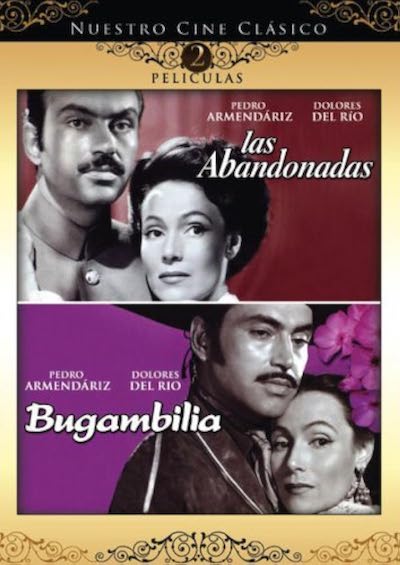
The fourth and most lavish of these is Bugambilia (1945). (The title, and the heroine’s nickname, is a florid purple flower that runs wild on every available wall in hot climates.) In this one, Dolores (refreshingly) does not play a poor but virtuous peasant waif, albeit one who strays in photogenic and melodramatic ways. Her role here draws on her own upper-class background. (Her family, like that of her distant cousin Ramón Novarro, had lost much of their land and fortune to the Mexican Revolution.) Here she plays a spoiled and capricious 19th century coquette, flouncing about in crinolines and bathing in an Olympic-size marble bathtub, afloat with rose petals.
Her character, of course, is instantly recognisable as Bette Davis in Jezebel (William Wyler, 1938) or Vivien Leigh in Gone with the Wind (Victor Fleming, 1939) or even Elizabeth Taylor in Raintree County (Edward Dmytryk, 1957). Yet much of our pleasure in Mexican melodrama lies in the way it emulates Hollywood models – yet also transforms them in unexpected, often subversive ways. Her key relationship, for most of the film, is not with her love interest (Pedro Armendáriz) but with her fiercely possessive (indeed, borderline incestuous) father. A rich widower, he cherishes her as “something more than a daughter…more like a living copy of her mother.” A huge Gothic portrait hangs on the wall, Rebecca-style, as if to prove the point.
Into this menage comes Armendáriz – a swarthy, moustachioed peasant whose profession (in a stroke of none-too-subtle symbolism) is that of cock fighter. He drops in to introduce his prize cock to del Rio’s prize laying hen. In what is surely a first for a ‘family’ movie, the cock mounts the hen while Dolores – her eyes widening in her exquisitely sculpted face – does a creditable job of looking shocked. Later on, she attends a grand ball, where she knows her lover is watching from the street outside, and has an enormous sequinned cock (of the bird variety) spangled on her fan.
We know, of course, that the liaison is doomed. Class barriers normally prove to be insuperable in Mexican movies, with a cynicism (or, perhaps, an honesty) that is rare in films from north of the Río Grande. Still, the ball scene is the film’s lyrical highlight, an orgy of billowing gowns and sparkling chandeliers that’s easily comparable to Vincente Minnelli’s film of Madame Bovary (1949). Platoons of waltzing ladies spread across the floor, petal-like, in overhead shots that might have been engineered by Busby Berkeley’s long-lost Mexican cousin.
An obsessively literal-minded viewer might complain (as Michael Caine did after a trip to Mexico) that del Rio and Armendáriz always look like film stars and never look like anything else, and “that is what is wrong with Mexican films.” Such a complaint is only slightly more logical than watching a performance of Swan Lake and saying that Rudolf Nureyev and Margot Fonteyn always look like ballet dancers – as if that detracts, somehow, from their dancing. We are dealing, in both cases, with a stylised art form that appeals on a supra-literal level of archetype and myth. No sane person, least of all a working class Mexican viewer of the 40s, would take Bugambilia for an exercise in gritty realism.
In fact, the opening and closing scenes (the bulk of the film is a long flashback) move Bugambilia away from the genre we think we recognise and into the realm of a Gothic ghost story. The mise-en-scene shifts to that of Rebecca (Alfred Hitchcock, 1940) or Dragonwyck (Joseph L Mankiewicz, 1946) or Portrait of Jennie (William Dieterle, 1948). Our heroine, sobered by her inevitable defeat, walls herself up inside her crumbling ancestral mansion. The camera (directed by the legendary Gabriel Figueroa) pulls back in a spectacular crane shot; we sense the ghosts of Miss Havisham and Norma Desmond hovering just outside the frame. Dolores del Rio is easily their equal in the high melodrama stakes. A pity that nobody in Hollywood had the sense to see it.


File Name .........................................: bugamb.avi
File Size (in bytes) ............................: 1,153,947,648 bytes
Runtime ............................................: 1:39:59

Video Codec ...................................: XviD ISO MPEG-4
Frame Size ......................................: 640x480 (AR: 1.333)
FPS .................................................: 23.976
Video Bitrate ...................................: 1340 kb/s
Bits per Pixel ...................................: 0.182 bpp
B-VOP, N-VOP, QPel, GMC.............: [B-VOP], [N-VOP], [], []

Audio Codec ...................................: 0x2000 (Dolby AC3) AC3
Sample Rate ...................................: 48000 Hz
Audio Bitrate ...................................: 192 kb/s [2 channel(s)] CBR
No. of audio streams .......................: 1
https://nitro.download/view/AA0981B0086A394/bugamb.avi
https://nitro.download/view/8ECB8FEA1F3071B/Bugambilia.srt
Language(s):Spanish
Subtitles:English
The post Emilio Fernández – Bugambilia (1945) first appeared on Cinema of the World.
]]>The post Emilio Fernández – María Candelaria (Xochimilco) (1944) first appeared on Cinema of the World.
]]>
Dolores Del Rio plays the indigenous daughter of a prostitute, and nobody in her village will buy the flowers she sells because of her family’s sordid history. The corrupt racist local merchant whose lecherous advances she keeps turning down demands that she pay her debts in full by tomorrow or else he’ll take her beloved little piglet! It is one of two Mexican films ever to win the Palme d’Or (the other being Buñuel’s Viridiana).
Allegedly when Dolores Del Rio (hot off the heels of her relationship with Orson Welles and a successful move from Hollywood back to her native Mexico) was presented with the opportunity to play the role she replied, “You want me to play an Indian? I … barefooted?”


1.27GB | 1h 37m | 706×529 | mkv
https://nitroflare.com/view/643F9C2AD4F3AE9/Maria_Candelaria_(1944).mkv
Language(s):Spanish
Subtitles:English, Spanish
The post Emilio Fernández – María Candelaria (Xochimilco) (1944) first appeared on Cinema of the World.
]]>The post John Ford – The Fugitive (1947) first appeared on Cinema of the World.
]]>
Museum of Modern Art writes:
In 1946, John Ford effectively took over the crew of his friend and fellow spirit Fernández—including stars Dolores del Río, Pedro Armendáriz, and Miguel Inclán, and cinematographer Gabriel Figueroa—and, with Fernández acting as his “first lieutenant,” filmed this abstract, ambitious work on locations in Mexico and at the Churubusco Studios. Ostensibly an adaptation of Graham Greene’s unfilmably scandalous The Power and the Glory, it derives many of its plot points from Ford’s 1935 The Informer, though the film’s ultimate subject is the Mexican landscape, as explored in all of its compositional possibilities by the incomparable duo of Ford and Figueroa.


2.72GB | 1 h 39 min | 804×576 | mkv
https://nitroflare.com/view/5862210767E39B0/The.Fugitive.1947.576p.BluRay.AAC.x264.mkv
Language:English
Subtitles:Japanese
The post John Ford – The Fugitive (1947) first appeared on Cinema of the World.
]]>The post Emilio Fernández – Flor silvestre AKA Wild Flower (1943) first appeared on Cinema of the World.
]]>
Hal [email protected]:
Completed before his immensely successful Maria Candelaria, Emilio Fernandez’ Flor Sylvestre was released second in the US-and not until two years after its initial Mexican release. Also known as Wildflower, the film features Fernandez himself as a character named Rogellio Torres. The lion’s share of the footage, however, is devoted to the romance between Esperanza (Dolores Del Rio), granddaughter of a common laborer, and Jose Luis Castro (Pedro Armendariz), the firebrand son of a landowner. Joining a revolutionary movements, Castro is disowned by his father, but Esperanza remains loyally by his side. Later on, Castro’s father is killed by outlaws; in seeking vengeance, he sacrifices his own life, while Esperanza carries on his revolutionary work with their young son in tow.


943MB | 1:30:35 | 608×464 | avi
https://nitro.download/view/F8380CF3FC8154F/Flor_silvestre_-_Emilio_Fernandez_(1943).avi
https://nitro.download/view/EC5CD30CB05F174/Flor_silvestre_-_Emilio_Fernández_(1943).srt
Language(s):Spanish
Subtitles:English
The post Emilio Fernández – Flor silvestre AKA Wild Flower (1943) first appeared on Cinema of the World.
]]>