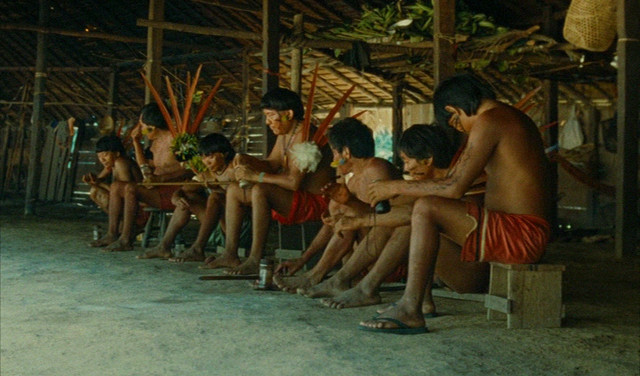
Quote:
During his stay in the Yanomami village of Watoriki with the anthropologist Bruce Albert, the French documentary filmmaker and photographer Raymond Depardon filmed in parallel a group of hunters and a group of Yanomami shamans in order to highlight – without having to explain – the close interdependence between the Shamanic metaphysics and the traditional knowledge of the forest.Read More »
Ethnographic Cinema
-
Raymond Depardon – Chasseurs et chamans (2003)
Documentary2001-2010Ethnographic CinemaFranceRaymond DepardonShort Film -
Hector Babenco – At Play in the Fields of the Lord (1991)
Drama1991-2000BrazilEthnographic CinemaHector Babenco

Two American mercenaries and a missionary couple arrive in a remote outpost, the Amazonian backwater town Mae de Deus. The local comandante tries to coerce the mercenaries into bombing the local tribe of Niaruna Indians so that their land can be annexed for gold mining.Read More »
-
Trinh T. Minh-ha – Reassemblage (1983)
1981-1990DocumentaryEthnographic CinemaExperimentalTrinh T. Minh-haUSAFrom Allmovie:
Director Trinh T. Minh-ha’s first film is an ethnographic portrait of rural Senegalese women, but its provocative editing and self-conscious narration question the very activities of ethnography and documentary filmmaking; Minh-ha inverts and critiques authoritative Western representations of the “other.'” ~ Sarah Welsh, All Movie Guide
INTERVIEW WITH TRINH MINH-HA
Interviewer Interviewed: A Discussion with Trinh T. Mihn-ha
by Tina Spangler
Emerson CollegeBORN IN VIETNAM, Trinh T. Minh-ha is a writer, composer and filmmaker She has been making films for better than ten years and may be best known for her first film Reassemblage, made in 1982. However her most recent film Surname Viet, Given Name Nam (1989), which examines “identity and culture through the struggle of Vietnamese women” has received much attention, including winning the Blue Ribbon Award at the American Film and Video festival Trinh T. Minh-ha is a professor of Woman Studies and Film at the University of California, Berkely and was recently a Visiting Professor at Harvard University.Read More »
-
Ben Russell – Let Each One Go Where He May (2009)
2001-2010Ben RussellDocumentaryEthnographic CinemaExperimentalUSALet Each One Go Where He May
Ben Russell
2009
2hr. 13min.Chicago-based filmmaker Ben Russell has gone international with Trypps – a series of short, mesmerizing films loosely interpreting the notion of “trip,” from literal, geographic journeys to ecstatic music-induced highs, variations of trance and spasmodic filmic episodes. Along with Tjüba Tën/The Wet Season (co-directed by Brigid McCaffrey), his medium-length experimental documentary shot in Suriname, and his live projector performances, Russell’s body of work displays an ever-increasing interest in cinematic anthropologies.
Let Each One Go Where He May is Russell’s stunning feature debut, a film that both partakes in and dismantles traditional ethnography, opts for mystery and natural beauty over annotation and artifice, and employs unconventional storytelling as a means toward historical remembrance. A rigorous, exquisite work with a structure at once defined and winding, the film traces the extensive journey of two unidentified brothers who venture from the outskirts of Paramaribo, Suriname, on land and through rapids, past a Maroon village on the Upper Suriname River, in a rehearsal of the voyage undertaken by their ancestors, who escaped from slavery at the hands of the Dutch 300 years earlier. The path is still travelled to this day and its changing topography bespeaks a diverse history of forced migration.Read More »